


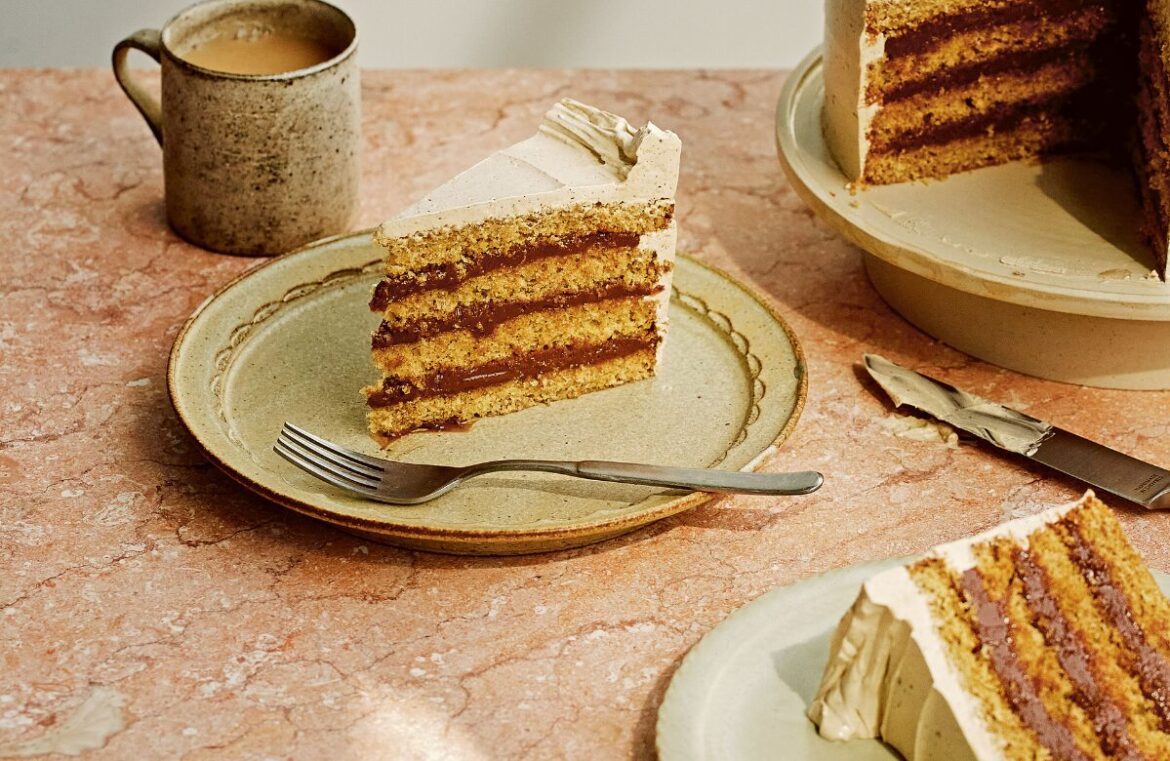
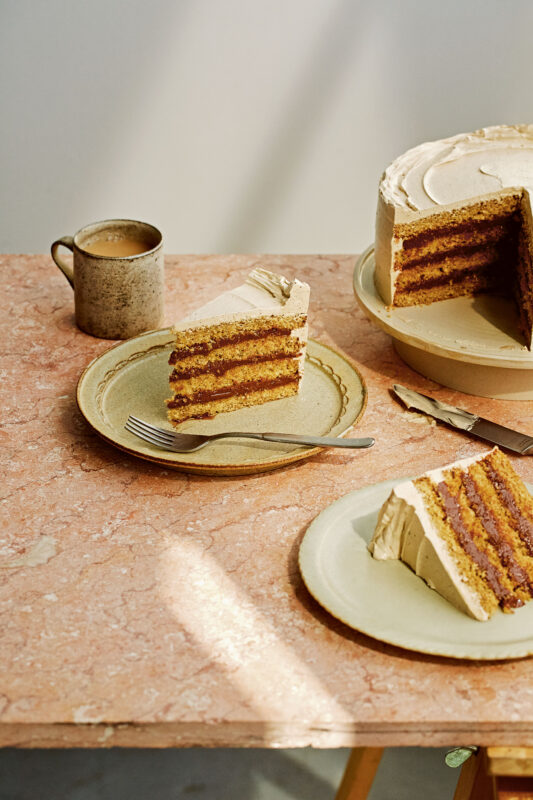
A nostalgic classic of graham crackers (or digestives for my fellow Brits), marshmallow and chocolate, s’mores are pure campfire comfort and a toasty, almost smoky, treat.
Getting that flavour into a cake isn’t hard but it does involves fire, well, a blowtorch at least. The meringue used to make the buttercream is blowtorched multiple times before the butter is added, giving the finished buttercream that burnt marshmallow flavour, a technique I learned from Kassie Mendieta, a fellow baker in the US.
To give the cake the requisite flavour of graham crackers, half the white flour is replaced with wholemeal and the cake is made with brown butter to make it appropriately toasty. To finish, it is layered with a rich, brown butter milk chocolate ganache.
Serves 12-16
WHAT YOU NEED
For the wholemeal brown butter cake
225g (2 sticks) unsalted butter, diced
265g (1⅓ cups) caster (superfine) sugar
150g (1 cup + 3 tablespoons) plain (all-purpose) flour
150g (1 cup + 3 tablespoons) wholemeal (wholewheat) or plain (all-purpose) flour
2¼ teaspoons baking powder
½ teaspoon bicarbonate of soda (baking soda)
½ teaspoon fine sea salt
3 large eggs
120ml (½ cup) buttermilk
1 teaspoon vanilla extract
For the brown butter milk chocolate ganache
125g (1 stick + 1 tablespoon) unsalted butter, diced
300g (10½ oz) milk chocolate, finely chopped
300ml (1¼ cups) whipping (heavy) cream
pinch flaked sea salt
For the burnt Swiss meringue buttercream
2 large egg whites
150g (¾ cup) caster (superfine) sugar large pinch fine sea salt
240g (2 sticks + 1 tablespoon) unsalted butter
1 teaspoon vanilla bean paste
WHAT TO DO
For the ganache, add the butter to a small saucepan, place it over a medium heat and cook until browned. The butter will first bubble and splatter as the water cooks out. Once the noise reduces and the butter starts to foam, watch for the milk solids to become separated out, little brown flecks, as this is when the butter has browned. Pour into a small heatproof bowl and refrigerate until thick and spreadable but not fully solid, 30–60 minute.
To make the ganache, put the chocolate in a heatproof bowl and melt. Place the cream and salt in a small saucepan, bring to a simmer, then pour a third over the chocolate and stir to combine. Mix in the remaining cream, in two additions, stirring until a smooth and glossy ganache is formed, then add the browned butter and stir until thoroughly combined. Finish with a short blend using a stick blender, to ensure the ganache is thoroughly emulsified. Cover and set aside, at room temperature, for 2–3 hours or until thick and spreadable.
Preheat the oven to 180°C/160°C Fan (350˚F). Lightly grease two 20cm (8 in) round cake tins (pans) and line each base with a disc of baking parchment.
To make the cake, put the butter in a saucepan, place over a medium heat and cook until browned, following the instructions above, then pour into a large mixing bowl and add the sugar, whisking to combine. set aside to cool for 10 minutes.
Sift the flours, baking powder, bicarbonate of soda and salt into a large bowl and whisk to combine.
Add the eggs, one at a time, to the butter mixture, whisking until fully combined before adding the next. Pour in the buttermilk and vanilla and whisk to combine. Add the dry ingredients and whisk briefly, just until a smooth batter is formed.
Divide the batter equally between the two tins, then bake in the preheated oven for about 25 minutes or until the cakes are pulling away from the sides of the tins and they spring back to a light touch. Allow them to cool in the tins for 10 minutes before turning out onto a wire rack to cool completely.
Use a serrated knife to slice each cake horizontally into two even layers. Place the first layer of cake onto a cake stand and top with a third of the ganache, spreading it in an even layer all the way to the edges. repeat this layering twice more. Finish by placing the last layer of cake on top. set aside whilst you make the buttercream.
Add the egg whites, sugar and salt to a large heatproof bowl and place over a pan of simmering water. Gently whisk just until the mixture is hot to the touch and you can no longer feel any grains of sugar. remove the bowl from the heat and transfer to the bowl of a stand mixer. Whisk the meringue for 3–4 minutes until it begins to hold stiff peaks but is still very warm. stop the mixer and lift the whisk from the bowl.
Use a blowtorch to caramelise the surface of the meringue, making it nice and toasty, as you would with a marshmallow over a fire. Make sure to blowtorch the meringue attached to the whisk as well. Whisk the meringue for a further 30 seconds before repeating the process. do this blowtorching at least 7–8 times until the meringue has taken on a warm caramel tone. Whisk the meringue for a few minutes more until it is no longer hot. Turn the mixer to medium speed and slowly incorporate the butter, a few pieces at a time. Once all the butter has been added, add the vanilla and continue mixing until a buttercream texture is formed. switch to the paddle attachment, turn the speed to low and mix until the buttercream is super silky and devoid of any air bubbles.
Spread the buttercream over the top and sides of the cake, decorating as you please.
Kept covered the cake will keep for up to three days.




COMMENTS