


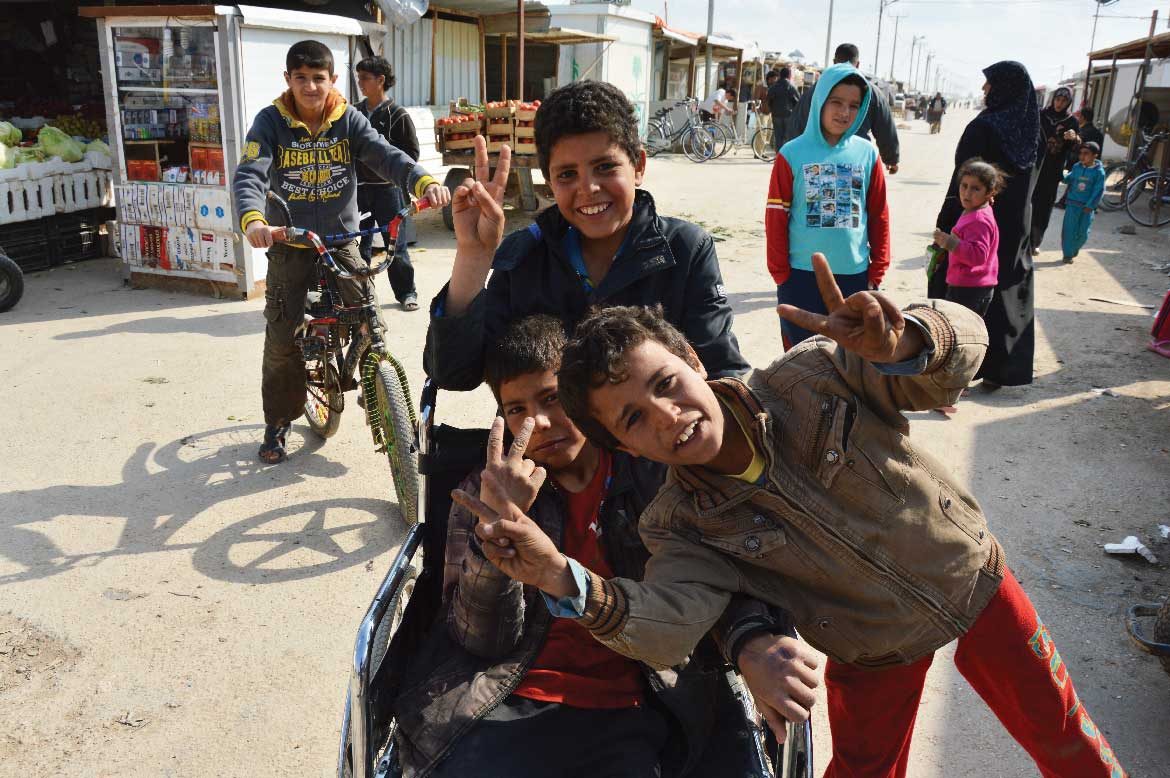
Zaatari Refuge Camp in Jordan provides shelter and assistance to many people who cannot return home to Syria because of war, and has hosted nearly half a million refugees since it began operating in 2012.
The camp currently hosts around 80,000 people, over half of which are children. It’s now so large that the camp forms Jordan’s fourth biggest city. Zaatari has sprouted markets, including an avenue of corrugated tin shops dubbed the “Champs Elysees”.
Among the stores are grocers, butchers and clothing stores as well as a bakery serving Syrian breads and sweets including konafa, maamoul and baklava.
The camp’s bakery is run by Abu Muhanned, who’s been at Zaatari for seven years.
“It was difficult in the start,” Abu told SBS, “but it’s easy now, even for the kids.”
Previously working at a poultry distribution company in Syria, Abu has learned the trade of baking to make a living in the camp.
Every day, Abu and his 13-year-old son Mohammed make flatbreads for shawarma sandwiches and Jordanian mansaf, fixing flatbreads against the hot side of a tandoor oven to bake. (A tandoor oven is a cylindrical oven, traditionally heated with a wood fire burning at the base. Flatbreads are stuck to the sides of the oven to bake.)
“This one has yeast,” Abu says in an SBS report, pointing to a pita before pointing to the flatbread next to it. “The other one doesn’t have yeast, to make it flat.”
Adam Liaw shone the spotlight on Zaatari recently when he travelled there as an ambassador for UNIFCEF. Adam told SBS, “One of the most interesting things I found about the camps is that many of the people operating the stores have learnt new skills. Many people who leave their homes, or in this case are forced to leave their homes, develop these new skills to find a connection to their culture that they’ve left behind and to make ends meet for their family.”
Adam says the most striking aspect of the camp is the size.
“I gasped when I saw it. It’s a sprawl of thousands upon thousands of dusty caravans and tents that stretch to the horizon, and without trees or other greenery to break the endless sea of monotony, it feels like it could go on forever.
“When you see it up close, however, Zaatari is made up of much more than a sea of temporary homes. It’s made up of people, and children.”
In June, UNICEF hosted #CookForSyria, a campaign that encouraged top chefs and homecooks alike to cook to raise money for people affected by conflict in Syria.
Harvest Newrybar participated in the campaign, serving slow-cooked lamb shoulder with Syrian-spiced freekah and caramelised onion puree. They sent five dollars from every dish to #CookForSyria.
Harvest’s Georgia Bateman says, “The Cook for Syria campaign taps into the enormous frustration people have in feeling helpless in the face of what they see happening in Syria. We want to do something to support the cause and hopefully this will empower people to make a small difference.”
Keep an eye on the #CookForSyria website for the next event and to purchase the #CookForSyria recipe book, which includes Turmeric Cake from Almond Bar, Love Cake with pears and pistachios from Bourke Street Bakery, and Fig and Walnut Galette from Flour and Stone.


COMMENTS