


Olive oil has long been a culinary staple, thanks in large part to its beautiful colour and light, subtle flavour. Baking Business caught up with Greg Mathews from Grampians Olive Co to hear about what it takes to make a bottle of the liquid gold.
Grampians Olive Co’s grove was established in 1943. Can you share some of the history with us?
The grove was established in 1943 by immigrant farmer Jacob Friedman under the Grampian Olive Plantations Co. At the time, it was one of the first and largest commercial olive groves in Australia.
In the early 1960s, the property was renamed Toscana, reflecting the Italian involvement in the grove’s establishment and the similarities between the local climate and landscape and Tuscany in Italy. The grove later traded under the Toscana and Grampians Olive Estate names. In 2015, we brought the two brands together as Grampians Olive Co. The name reconnects with the original business and better reflects where the olives are grown and produced.
Today, Grampians Olive Co. remains a small, 100 per cent Australian family-owned business, run by two generations of the Mathews family. We specialise in premium certified organic extra virgin olive oil, with the original trees still producing more than 80 years after they were planted. So our property is both a working farm and an important part of Australia’s olive-growing history.
How has the plantation changed and evolved since then?
The original olive trees and the Grampians landscape have remained the constants. What has changed most is the machinery, harvesting methods and processing technology, which give us much greater control over timing, consistency and quality.
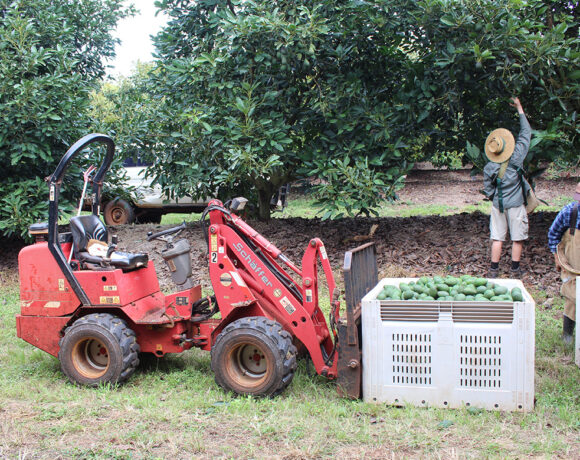
Harvesting was once much more dependent on manual labour. What previously took up to six months can now be completed in six to eight weeks. While we still hand-pick our table olives, we use a trunk shaker for oil production, allowing us to harvest the fruit efficiently and at the right stage of ripeness for the style and quality of oil we want to produce.
We installed a new olive press on the farm in 2023. This has given us greater control over processing and helped us improve consistency and quality. Having the mill on the property means we can process the olives soon after harvest.
We have also continued to refine our pruning, soil management, mulching, grazing and harvesting practices to suit dryland conditions. Every season is different, so the way we manage the grove must respond to rainfall, heat, crop size and tree condition.
Today, our range includes certified organic extra virgin olive oil, infused olive oils, table olives, vinegars, dukkah, honey, gift packs and olive oil skincare. We also operate a farm shop and café on the property.

The Grampians Olive Co orchards
How large is the plantation, and how many trees do you have? What olive varieties are there?
The property covers about 500 hectares and includes around 28,000 olive trees. It is certified organic by Southern Cross Certified Australia.
Although the property is large, the grove is traditionally spaced, dryland farmed and relatively low yielding. The trees are planted around 10 by 10 metres apart, rather than in the tightly packed rows found in modern intensive groves, and rely entirely on rainfall with no irrigation.
The wide spacing allows each tree to develop a large canopy and extensive root system, helping it access moisture and nutrients across a greater area. Sheep graze between the trees as part of our broader organic land management system, helping manage groundcover and make productive use of the wide interrows.
Our production remains low compared with modern intensive groves, allowing us to stay hands-on and focused on quality rather than volume.
Although the original planting records have been lost over time, the main identified varieties producing today include Verdale, Mission, Frantoio, Bouquettier and Benito. Some trees remain unidentified, but each tree contributes to the unique flavour profile of our oils. Some create softer, more delicate oils, while others contribute greater fruitiness, bitterness and pepperiness. The flavour of the oil also depends on the season and the stage of ripeness at harvest. This allows us to produce several different styles of extra virgin olive oil for different tastes and uses.
What does a day on the plantation look like?
It changes considerably throughout the year.
During harvest, the main focus is on operating the tree shaker, collecting the olives, transporting them to our on-farm press and processing them as quickly as possible. Harvest can involve long days because timing, fruit condition and weather all matter.
Outside harvest, the work includes pruning, mulching, soil management, machinery maintenance, weed and pest management, and managing sheep grazing through the grove.
There is also the production and customer side of the business, including bottling olive oil, packing customer orders and serving visitors at the farm shop.
We are a small team, so most people work across several parts of the business. That hands-on approach is important to us because it means the same family and team remain closely involved from the grove through to the finished product.

Harvesting at Grampians Olive Co
Can you tell us about the harvesting and processing process? How long is the growing season?
Flowering generally occurs in late spring, with the fruit developing through summer and autumn.
Harvest usually begins in late April and continues into June. The timing depends on the variety, seasonal conditions, fruit maturity and the style of oil we are aiming to produce.
Earlier-harvest olives generally produce greener, more bitter and peppery oils. Later-harvest fruit tends to produce softer, rounder and milder oils.
We harvest olives for oil production using a trunk shaker. The fruit is then transported directly to our on-farm olive mill, where it is cleaned, crushed and processed to extract the oil.
The olives are crushed into a paste, which is mixed under controlled conditions before the oil is separated from the water and olive solids using mechanical equipment. No chemical extraction is used in the production of extra virgin olive oil.
Speed is critical. Once olives have been harvested, delays, heat and damaged fruit can quickly reduce freshness and overall quality. We aim to process the fruit as soon as possible after harvest.
Having the press on the farm gives us much greater control over the process, from the tree through to the finished oil. The oil is then stored in stainless steel tanks and protected from heat, light and oxygen before bottling.
As a small family producer, this control matters. It allows us to focus on quality rather than volume and to manage each stage carefully.
What is a common misconception about olive oil?
One misconception is that extra virgin olive oil becomes toxic when heated. In fact, it is suitable for baking and most everyday cooking. Its natural antioxidants help protect the oil from oxidation, while its high level of monounsaturated fat also makes it relatively stable under heat. While some flavour and antioxidants are reduced during cooking, especially at very high temperatures or over long periods, the oil does not suddenly become unsafe. Good-quality extra virgin olive oil can be used for roasting, frying and baking, as well as dressings, marinades and finishing dishes.
Another misconception is that a stronger, more bitter olive oil is automatically better.
Bitterness and pepperiness can indicate the presence of naturally occurring polyphenols, but intensity alone does not determine quality. Freshness, balance, aroma, processing quality and suitability for the intended use are just as important.
An oil can be very high in polyphenols but still be too strong or unbalanced for a particular recipe. The best oil depends on how it will be used and the flavour the cook wants to achieve.

Some of the Grampians Olive Co products
What should bakers and pastry chefs keep in mind when choosing or working with olive oil?
Olive oil should be treated as an ingredient with its own flavour and character, rather than simply as a neutral fat or a substitute for butter. The best results come from matching the oil to the product.
The first consideration is flavour.
A robust extra virgin olive oil works well in focaccia, crackers, savoury pastries and recipes containing herbs, garlic or strong cheese.
A softer, more delicate oil is generally better for cakes, biscuits, friands and pastries, where the olive oil should complement the other ingredients rather than dominate them.
Freshness is important. Olive oil should smell clean and fresh, without stale, waxy, musty or rancid aromas. Australian extra virgin olive oil is usually fresher as it has spent less time in storage and transport than imported oil. That means more of its original aroma and flavour is likely to remain.
Bakers should also remember that olive oil behaves differently from butter. Olive oil is liquid and contains virtually no water, while butter contains both fat and water, so recipes may need some adjustment.
Olive oil is particularly useful in cakes because it helps retain moisture and can keep the crumb soft for longer.
Is there anything else you’d like to add?
As a small family business, we focus on quality rather than volume. Organic certification is central to our ethos, and quality depends on careful control at every stage of production. We grow the olives, harvest them, process them in our on-farm mill, store the oil carefully and bottle it ourselves. That close involvement from tree to bottle is central to how we work and to the quality of the oils we produce.
For bakers and pastry chefs, the simplest advice is to choose fresh Australian extra virgin olive oil from a producer they trust, taste it before using it and select a style that complements the other ingredients.


COMMENTS