


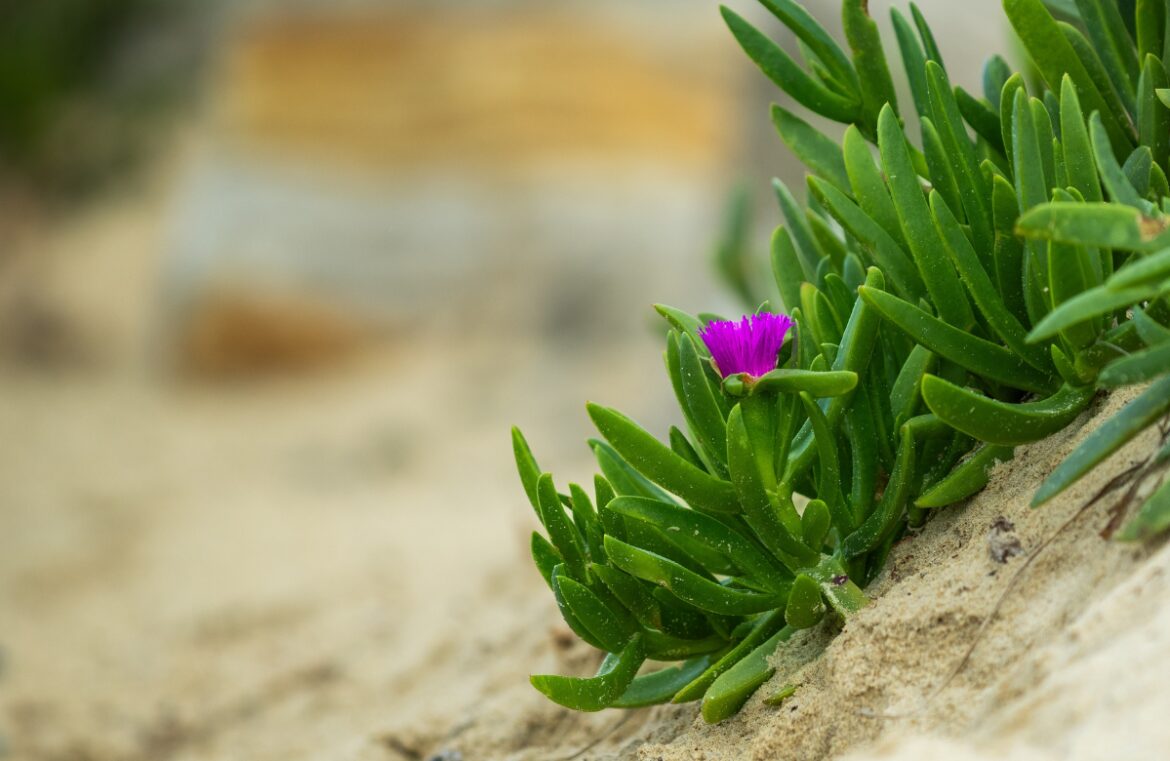
UNSW Researchers are exploring how an Australian native coastal plant could help improve both the strength and flexibility of biodegradable films.
The plant, colloquially known as pigface, has been used by Indigenous communities for food and medicine and is a hardy coastal succulent. The scientists have discovered that by adding extracts from pigface to seaweed-based films can significantly improve their strength and flexibility.
Led by Dr Rishi Ravindra Naik from UNSW School of Chemical Engineering, the research is part of a broader project supported by UNSW Societal impact Seed Funding in collaboration with Indigenous-led nursery IndigiGrow.
As the world deals with growing plastic pollution, researchers are increasingly looking to natural materials as alternatives to conventional plastics.
One promising material is agar, a jelly-like substance extracted from seaweed that cane be used to create thin, transparent biodegradable films. While agar is renewable and biodegradable, films made from the materials are often too brittle and sensitive to moisture for practical applications.
Dr Naik explained that when used by itself, agar will crumble in your hand.
“If it’s going to be used in the real world, it needs to be more durable,” he said.
Dr Naik and his team wanted to investigate whether natural compounds found in pigface could offer a similar benefit as that of plasticisers – ingredients that help make materials more flexible.
Their attention turned to pigface, a drought-resistant succulent commonly found along Australia’s eastern coastline. The plant’s fleshy leaves contain a range of naturally occurring compounds, including sugars, organic acids and polyphenols, which the researchers believed could influence the properties of biodegradable materials.
The team extracted these compounds from pigface leaves and combined them with agar to create nine different film formulations. They tested each film’s strength, flexibility, moisture resistance and antioxidant activity. One formulation was about 38 per cent stronger than the agar-only film and could stretch almost twice as far before breaking. It also reduced the material’s water vapour permeability by about 57 per cent, allowing less moisture to pass through the material compared with films made from agar alone.
“Funnily, we thought if we added more pigface extract, it would improve our results – but it didn’t,” Dr Naik said.
“Films containing an intermediate amount performed best overall, while higher concentrations reduced their strength and flexibility.
“The findings suggest that pigface contains compounds that could help improve the performance of biodegradable films, although further research is needed to better understand exactly how they work together.”
Although the findings are promising, Dr Naik said the research is still at an early stage.
One of the challenges now facing the research team is the material’s sensitivity to water. Although the pigface improved the film’s ability to allow less water vapour to pass through, they still dissolved substantially when immersed in water. This makes them unsuitable for many conventional packaging applications, particularly those requiring prolonged exposure to moisture.
“A possibility is packaging for dry products, although further improvements and safety testing would be needed before the material could be used in contact with food,” Dr Naik said.
The project was undertaken with Indigenous community approval, with the researchers committed to sharing their findings so communities can decide how the knowledge is used and developed.
“All the knowledge belongs to the Indigenous people so they can use it the way they want to,” Dr Naik said.
“I hope these findings will inspire further research into Australia’s native plants, while helping ensure communities remain central to decisions about how their knowledge and resources are used.”


COMMENTS