


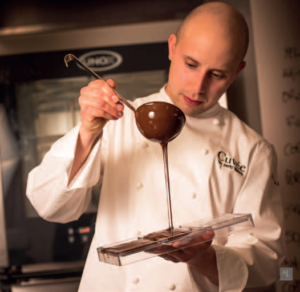
Deniz karaca has two great passions: Chocolate With Wine. now, the World chocolate masters finalist has brought the two together in a unique business venture. We catch up with Deniz to talk about how he’s pairing great wine with artisan chocolate under his brand, cuvée chocolate.
MOST PEOPLE HAVE ENJOYED WINE AND CHOCOLATE TOGETHER AT SOME POINT, BUT WHAT INSPIRED YOU TO CREATE A BUSINESS OUT OF IT?
Wine and chocolate, paired or not, have been two great passions of mine that are constantly present in my career and in my general life. But they really came together when I represented Australia at the World Championships for Chocolatiers, the World Chocolate Masters, in 2013. We were presented with an ‘architecture of taste’ theme, which I saw as a great opportunity to marry these two passions. After months of development and research, I served the jury a degustation of chocolate pralines, desserts and entremets, all accompanied by wines from South Australian winemaker Penfolds and their Grange range. It was so well-received by the jury, I realised there was a market for it.
WHAT KINDS OF CHOCOLATE ARE BEST PAIRED WITH WINE?
It’s not so much the type of chocolate, but the quality of the chocolate. To enable the characteristics of the wine to work with the different layers of the chocolate, it must display outstanding purity, and be handcrafted by using a blend of the very best cocoa beans, sourced from selected regions around the world according to their terrain, climate and altitude.
WHAT KIND OF WINE GOES BEST WITH MILK CHOCOLATE?
A rich milk chocolate with strong hints of caramel throughout the front palate, for example, lends itself to slight roast notes and a buttery finish. Great matches for the Soleo 38 per cent milk chocolate include sémillon, riesling, moscato, rosé, botrytis, port, tawny, muscat and even a buttery wooded chardonnay
WHAT ABOUT DARK CHOCOLATE?
Our Amphora 65 per cent dark chocolate comes from a single plantation nestled within the ancient rainforests of Peru. It has strong impressions of red and tropical fruit in the front palate, followed by complex layers of natural acidity, which makes it appear considerably less sweet than a common 65 per cent dark chocolate. With this in mind, I’d pair it with pinot noir, merlot, grenache, shiraz, cabernet sauvignon, zinfandel, port or tawny.
CAN CHOCOLATE BE PAIRED WITH COGNAC OR SCOTCH?
There are no rules when it comes to chocolate! Cognac and scotch go well with dark chocolates that have a hint of acidity in the back palate that tends to linger for a bit. Our Grand Cru 75 per cent dark chocolate (Criollo and Forastero) has origins in the wild earth of Africa. There are lots of cherry and red plum breaking through the slight bitterness of the cocoa, making it perfect for the chocoholic that prefers less sweetness and more cocoa. It’s also a great match for shiraz, cabernet sauvignon, cabernet merlot and even sangiovese.

WHAT ARE YOUR BEST TIPS FOR TASTING CHOCOLATE WITH WINE?
It’s easy; just follow these four steps. Remember, there are no set rules. Have fun and experiment with different products. At the end of the day, everyone has his or her own specific tastes and expectations.
1. Prepare yourself
Ensure the chocolate is at room temperature; never refrigerate chocolate unless it’s in a humidity-controlled wine fridge. Let the matching recommendations on your Cuvée Chocolate bar be your guide, but feel free to experiment. Open the wine and let it breath ideally two hours prior, the contact with the oxygen will help it unfold its full potential.
2. Taste the wine
If possible use a large glass, swirl the wine, put your nose to the glass and take in its aromas. Have a small sip and let it dance in your mouth, close your eyes and try to memorise everything you can taste and in what order. Cleanse your palate with a glass of water
3. Taste the chocolate
Break off a bite-sized piece of chocolate and take in its fragrance. A darker chocolate should smell slightly acidic, while a milk chocolate has sweeter caramel undertones. Place the chocolate on your tongue and close your mouth. Don’t chew it – let the chocolate melt for a moment in your mouth and let your body become one with the cocoa.
4. Go back to the wine
Taste the wine again, swirl it, smell it, let it tickle your tongue and become one with the aromas of the chocolate. Has the wine changed? Has the chocolate? Take note of how the taste structure of wine and chocolate are complementing each other. Repeat it… indulge!


COMMENTS