


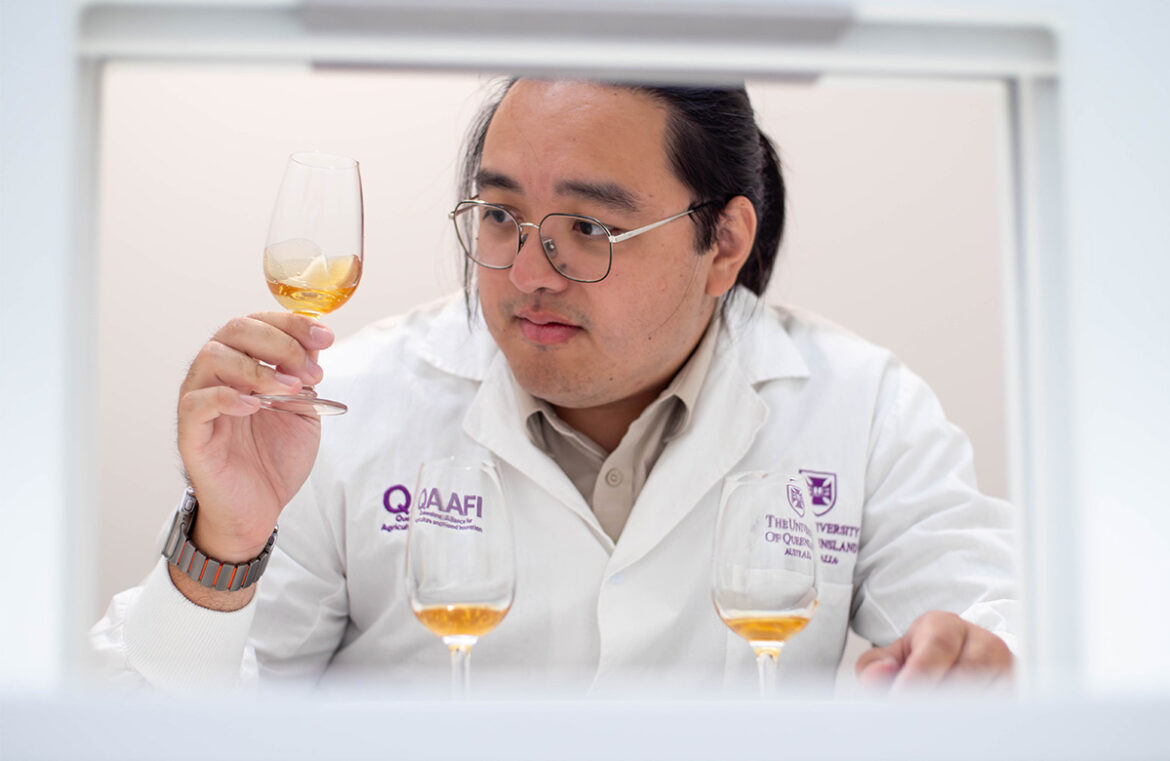
Research at the University of Queensland is determining whether the way honey is harvested and stored could ultimately affect the taste and quality of the product.
Queensland Alliance for Agriculture and Food Innovation PhD candidate James Yu Jun Lian said his work aims to safeguard the future of premium Australian honeys.
“This is the first detailed look at how gentle extraction may preserve Australia’s unique botanical flavours,” he said.
“It opens the door to defining what freshness means in honey, which is something the industry has never formally measured.”
The research compared honey from three locations across South East Queensland and Northern New South Wales using two different extraction methods. The first was the traditional Langstroth hive and the second was the Australian-made Flow Hive. Both were followed by commercial processing.
“The processes used for the past century with the Langstroth hive expose honey to heat, oxygenation and vibrations,” Mr Lian said.
“Heating and spinning honey to extract it from the frames means different honeys can become similar in flavour, rather than distinctive.
“Those processes can damage the beautiful botanical notes that give Australian honeys a unique bouquet, thus reducing their intrinsic value.
“The Flow Hive minimises any disturbance to the hive while allowing the honey to flow naturally with no extra heat and minimal agitation.”
Mr Lian said the honey extracted from the Flow Hive had a lighter colour and lower levels of hydroxymethylfufural or HMF – a compound used to measure the quality of heat exposure of honey.
“Lower HMF and lighter colour signals reduced chemical damage to honey,” Mr Lian said.
“We’ve also compared the aroma and flavour of heated and aged honeys, which became more caramelised and medicinal in taste, proving that heat and oxygen detrimentally affected their flavour.”
Sensory scientist Professor Heather Smyth said work was underway to find ways to show and measure a honey had been damaged.
“There’s a huge interest globally in understanding honey freshness and how different processing methods influence quality,” Professor Smyth said.
“Honey lacks the well developed freshness metrics found in industries like wine and coffee, and this work is helping establish those foundations.
“This includes things like colour, texture and physical properties of the honey but also its composition in terms of sugar content and flavour.
“Odour compounds can tell us something has been bruised or damaged, like the acetaldehyde note of a bruised apple tells us something has been lost.”
Now, the team plans to track how honey changes post-harvest, aiming to pinpoint when key quality shifts occur and how different extraction methods can influence flavour, aroma and texture.
“We want to take advantage of the varieties of boutique Australian honeys compared to other countries and open opportunities for high value gastronomic applications,”Mr Lian said.
“Our honey should be valued for their unique aroma profiles and the flavour linked to our native plants.”


COMMENTS