


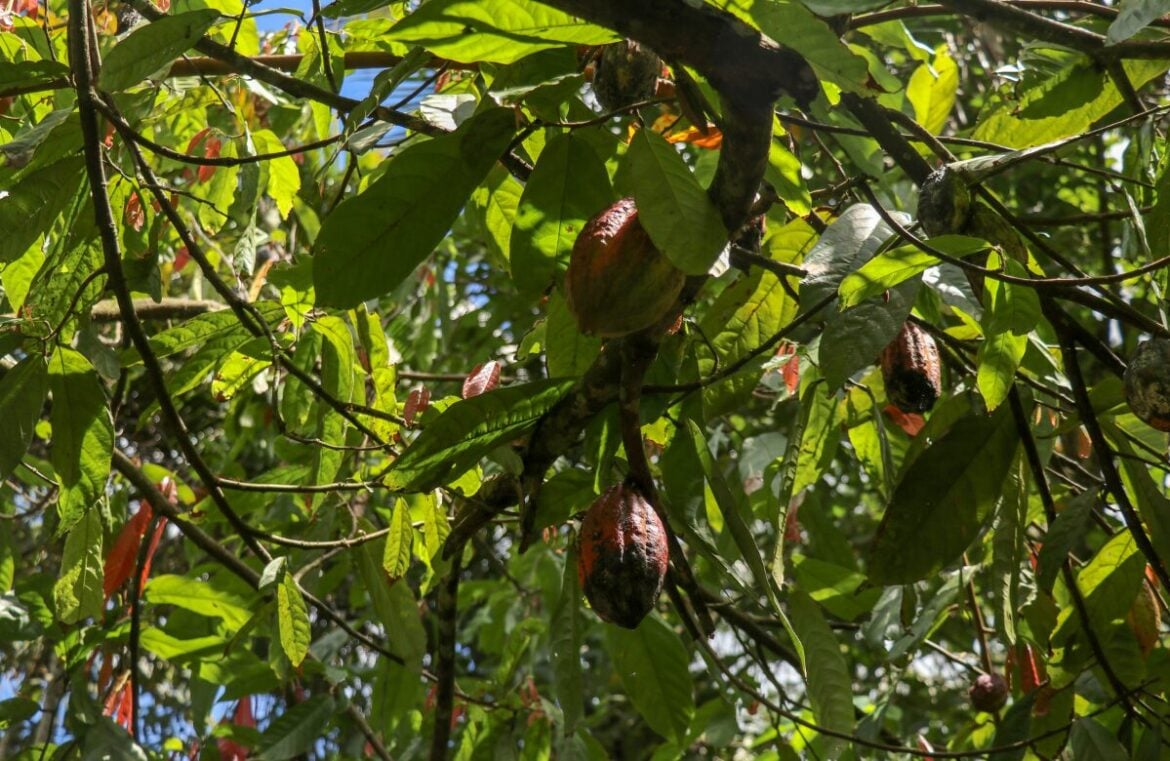
A research team from the University of Queensland has found that growing more shade trees on cocoa farms in West Africa could significantly reduce carbon emissions associated with the global chocolate industry.
The study, published in Nature Sustainability, suggests that increasing tree cover in Ghana and Côte d’Ivoire—the region responsible for 60 per cent of the world’s cocoa supply—could hold up to 10.2 million tonnes of carbon dioxide equivalent (CO₂e) annually.
Led by Dr Wilma Blaser-Hart and Dr Simon Hart from UQ’s School of the Environment and Centre for Biodiversity and Conservation Science, the research utilised satellite imagery and machine learning to assess current levels of shade tree cover in cocoa-growing regions.
The findings revealed that current shade coverage is approximately 13 per cent—far below optimal levels.
“Cocoa is naturally an understory tree in rainforests, but in monoculture farming systems it’s grown in the open,” Dr Wilma mentioned in the study.
“Shade trees growing in cocoa farms can sequester substantial amounts of carbon in both aboveground and belowground biomass.”
The researchers argue that cocoa can be grown effectively with 30–50 per cent shade without yield reductions, indicating significant untapped potential for climate mitigation.
Modelling showed that a minimum shade level of 30 per cent across both countries could offset about 9 per cent of total annual national emissions, and 167 per cent of current cocoa-related emissions.
However, when factoring in emissions from historical deforestation and land-use change, the mitigation potential drops to around 15 per cent.
Still, the benefits of shade tree planting go beyond carbon storage. According to Dr Wilma, “planting a variety of trees in plantations will support biodiversity, improve soil fertility and temperature regulation, and reduce pest and disease pressure.”
The researchers also caution that agroforestry alone cannot replace the ecological value of intact forests.
“Agroforestry can deliver meaningful mitigation, but it is not a substitute for protecting natural forests and this must remain a priority,” Dr Wilma said.
Dr Simon noted the broader implications of the study, highlighting the potential for their methods to be adapted to other cocoa-producing regions and other perennial shade-tolerant crops like coffee.
“For cocoa, tree planting on farms is a win-win situation,” he stated in the study.
“It’s a clear environmental benefit for the chocolate industry through growing a carbon sink with no loss of crop production,” he said.




COMMENTS