


In Turkey, ‘hospitality’ is more than a catch-cry; it’s a way of life. Irini Cavalliotis catches up with popular chef Shane Delia to talk about the spices, traditions and love for culture that makes up the fantastically diverse genre of Turkish baking.
With renewed pride in their Ottoman past, Turkish bakers and chefs are rediscovering the ancient recipes that were served to the Sultans hundreds of years ago.
Although largely misunderstood in Australia, the exceptionally diverse recipes that make up Turkish baking – including woodfired sourdough, honey-drizzled pastry and rosewater-infused desserts – are perfectly suited to the local palate.
One Australian chef who is lighting up the Melbourne food scene with his contemporary twists on traditional Turkish flavours is Shane Delia, head chef and owner of modern Middle Eastern restaurant Maha.
Is it possible to sum up Turkish baking in a few words?
Hardly! Turkish food is a very diverse cuisine that encapsulates all the regions the Ottoman Empire ruled over. Modern Turkish cooking has everything we have here in Australia and in other cuisines, but ancient Turkish cooking is so deep-seated and perfected it’s truly eye opening. It’s all about using really high-quality products and creating beautiful flavour profiles without trying too hard.
Do australians misinterpret Turkish baking and general cuisine from this region?
Yes, just like we did in the ’80s when we thought we knew what Chinese cuisine was. We still haven’t matured as a nation to take in the food of Turkey; it’s not the Middle East. There is more to Turkey than the Aegean Coast or the Mediterranean. It’s a huge country that’s boarded by Georgia, Armenia, Syria and the Black Sea – all these beautiful regions that influence its diversity of cuisine. We’re really into Turkish bread over here – the high in yeast, sesame encrusted flat loaf – which is great, but it’s not truly indicative of the bread in Turkey.
Does the same goes for the kebab?
When Australians think of a kebab we think of dodgy, greasy fast food, wrapped in foil and shoved down our throats at 2am. But it’s meant to be a light, refreshing meal. Of course, a big part of the kebab is the meat, but I would dare to say the most important element is the bread. There is no point having great meat cooked on the grill over coal if you don’t wrap it in handmade, fresh bread. We’re just not quite there yet in Australia, in terms of understanding Turkish cuisine.
If Turkish people aren’t eating the yeast breads we market over here as Turkish bread, what are they eating?
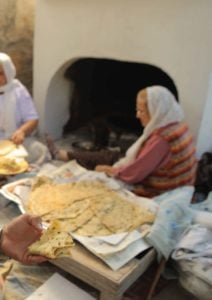
A lot of baking happens at a village level in Turkey and the style of bread, as with any food, varies greatly depending on the region. Because so many remote communities are nomadic, we did get to see a lot of sourdoughs baked in traditional woodfired ovens. The main variety of sourdough I saw was a heavy loaf, similar to what you’d find in a traditional ciabatta cobb-style loaf, with a really thick crust. The bread on the inside was really quite dense and there were not a lot of air pockets. It had a really strong, overpowering sour that is truly beautiful.
Are the pastries also very region-specific?
Yes, in fact, we specifically headed out to an area called Gaziantep, in south-east Turkey, to taste baklava. The Imam Cagdas bakery is internationally renowned for making the best baklava, not only in Turkey, but perhaps the world. Spending time with those guys and understanding the amount of dedication and work that goes into producing this baklava was an eye-opening experience.
Did you get to sample any of Turkey’s renowned hazlenuts?
We specifically visited Urdu, an area on the Black Sea-side of Turkey that is the biggest producer of hazelnuts in the world. The locals have taken techniques from around the world, mastered them and adapted them so everything has a hazelnut base. They’ve got hazelnut macarons, batters, pastries and breads in Urdu, and it’s all really high-end because the quality of the raw materials is so good.
Is there a lesson to be learnt here; perhaps it’s better to master one speciality than try to be experts in a range of recipes and styles?
I saw people make centuries-old recipes so effortlessly and it gave me a new respect for home cooking; those cooks who only make a few things, but make them well and with soul. We were in Kayseri with the local ladies making munti, simple little dumplings made from flour, water and dough and rolled out paper-thin on a board and cut into minute squares. I’m talking half a centimetre, with a little meat filling in between and crimped to make tiny triangles. The dumplings are so small you can fit about 40 on one spoon! These women make them alongside their mothers and their grandmothers with such little effort.
What role does spice play?
Spice is a big factor, but the difference in Turkish food, and in the Middle East as a whole, is that spices are used in a singular sense to pronounce flavour rather than to mask it, as cooks do in the subcontinent. In Africa, India, Sri Lanka and Pakistan, myriad spices are brought together to create a base. But in Turkish food, it’s about adding a fragrant element. And you might only use one spice, like an Aleppo pepper. It’s dependent on the region, which you can see if you turn your back to the Aegean and start to move through to the Syrian border – you feel the climate change and the spices with it.
How can bakers and pastry chefs turn to Turkey for inspiration?
Inspiration will come from the product. Turkish pastry, like Yufka, is an amazing product and soon, there will be demand in Australia for artisan products like this. When this happens,
chefs and pastry chefs will have to take note and start producing them. We’re like Switzerland here in Australia; there are no political or religions boundaries and there are no cultural barriers. We can do what we want.
Take Sütlaç for example, a rice pudding with sugar, salt and milk – I had it in Turkey at its premium. It’s simple, but the rice was from the region, the sugar was from 3km away and the milk was from cows in the next field and it was unbelievable. Then, one cold and raining Melbourne day I remembered the Sütlaç we ate and thought, “if I had some marshmallows right now, I’d be wrapped”. So as soon as I got home I took some marshmallows and adjusted the recipe to do a toasted marshmallow Sütlaç with a little chocolate sorbet.
How important is it to respect where a recipe has come from?
Taking bits and pieces from a culture and making something unique, while staying true to the region and its people, is the best way to pay homage to a regional cuisine. You’re never going to create that dish as good as it was up in the mountains. So acknowledge that and do
something that represents it, rather than try to replicate it and make something that’s subpar.
Will Turkish baking gain popularity? Surely the flavours are in line with the australian palate.
Think about it; Aussie’s go stupid for any meat that can be wrapped in bread or pastry! Watch out for Turkish food in the next 10 years, it will become a big thing.
Shane’s zest for life and enthusiasm for food and culture come together in his latest television endeavour; Shane Delia’s Spice Journey – Turkey, airing on SBS ONE at 7:30pm every Thursday with the finale on October 2.
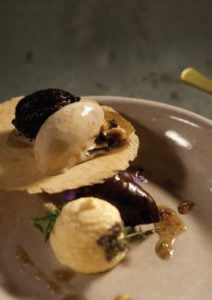
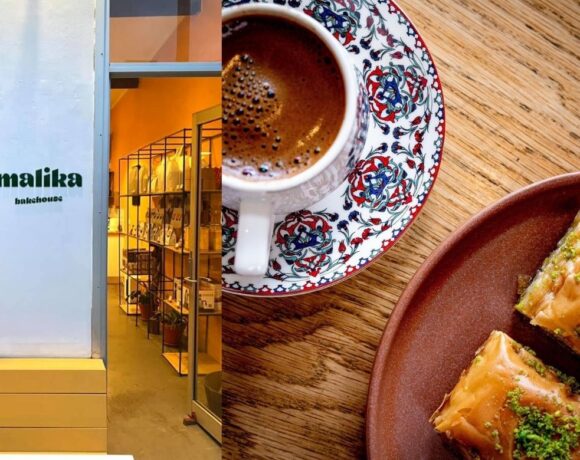
TURKISH COFFEE AND KAYMAK BAKLAVA
“What makes Turkish baklava so good is that the first layer of pastry is spread with kaymak, a thick rich cream that adds a buttery silkiness. I would never try to improve on baklava – it’s pretty perfect just as it is, but this version takes some of the best elements and combines it with Turkish coffee to make a pretty good twist on a classic,” Shane says.
Serves: 6
Preparation time: 1 hour
Cooking time: 30 minutes
Chilling/freezing time: overnight
You will need to begin this recipe a day ahead.
Ingredients
Turkish coffee ice cream
• 50ml milk
• 6 egg yolks
• 70g sugar
• 500ml (2 cups) water
• 5tsp Turkish coffee
Chocolate ganach
• 160g dark chocolate, finely chopped
• 160ml thickened cream
• 40g cold unsalted butter, finely chopped
Kaymak cream
• 2 egg yolks
• 200g kaymak (see notes)
• 50g sugar
• 2 sheets gold strength gelatine
• 170ml pouring cream
Yufka pastry disc
• 2 sheets yufka pastry (see notes)
• 100ml ghee, melted
Pistachio and hazelnut garnish
• 2tbsp slivered pistachios, slivered
• 2tbsp hazelnuts, roasted and peeled
• 1tbsp finely chopped preserved orange
• 2tbsp candied walnut or fig syrup (see notes)
To serve
18 thyme flowers
Method
1. To make the Turkish coffee ice cream, I would normally prepare the anglaise (custard) in the restaurant using a Thermomix. To do so, place the milk, egg yolks and sugar in a Thermomix set to 80 ̊C and blend for about 7 minutes. When the time has elapsed, blend on speed 7 for 5 seconds, then pass through a fine sieve into a jug, cool, then refrigerate for 2-3 hours or until chilled
2. To make the anglaise the old-fashioned way, bring the milk to the boil and set aside. Whisk the egg yolks and sugar until thick and pale, then slowly pour in the hot milk, whisking continuously. Return the mixture to the pan over medium-low heat. Cook, whisking continuously until the mixture reaches 80°C. Transfer the anglaise to a blender and blend for 10 seconds. Strain through a fine sieve into a jug, cool, then refrigerate for 2-3 hours or until chilled.


COMMENTS