


Russell Morrison says the recipe for making shortbread is easy, but the technique is something you need to master. he walks us through his hands-on recipe for creating shortbread that’s pale, brittle and snappy with just the right amount of buttery flavour.
About Russell Morrison
Russell Morrison began baking when he was 15. During a trip to Scotland, he starting collecting recipes that pre-date 1700 and decided if he ever started his own bakery, he’d make it specifically English, Irish, Welsh, or Scottish.
Russell Morrison dream is now a reality in Celtic Bakery, where he spends his days passing on his knowledge of shortbreads, Christmas mince pies and other biscuits and cakes to his son Ken.
Russell Morrison says, “When old buggers like us kick the bucket, nobody will know about this stuff. So I’m passing it all on to Ken so he can go around bullshitting, I mean, talking about it!”
He adds, “If you want to make something nice and you’re trying to keep certain traditions going, you’ve got to attempt to make it in the same manner that it was always made. It may not be the most financially viable way to make it or the quickest but we take great pride in it. We don’t pump out thousands and thousands of packets every week but we can make a few hundred a week.
“A lot of people don’t taste shortbread that’s made with butter. A lot of shortbread’s made from oil and people have forgotten what real, good home-style baking tastes like. So they get surprised when they can taste the difference.”
WHAT YOU NEED
One part sugar, two parts butter, three parts flour. So you can adapt it to your own quantities.
If you’re keeping it really simple, it would be:
100 grams of caster sugar
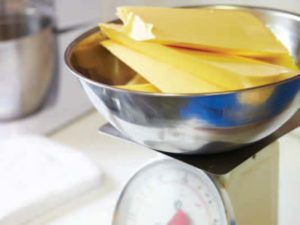
200 grams of unsalted butter
300 grams of plain flour
We use a kilo of sugar, two kilos of butter, and three kilos of flour to make our batches, because that’s what fits the mixing bowl—it’s as easy as that.

WHAT TO DO
1. CHOOSING THE RIGHT INGREDIENTS
You need to use caster sugar in shortbread. If you use 1A sugar, you’ll get little pit-holes in the top because the sugar won’t dissolve into the dough until it’s in the oven. It should be dissolved into the butter before you add the flour.
You also need to use good-quality butter that doesn’t contain too much water. If you’ve got butter with too much water in it, the dough will crack and won’t form into a nice piece.
We use caster sugar, unsalted butter and plain flour.
2. MIXING THE SUGAR AND BUTTER
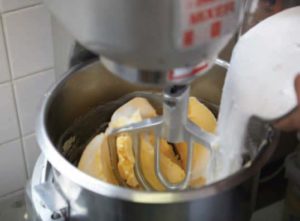
Mix the sugar and butter together but don’t cream it. Mixing is ready when it starts sticking to the sides of the bowl—it doesn’t matter what bowl you use—when it starts to catch on the side, it’s time to add the flour.
If you add the flour too early though, the sugar won’t emulsify into the butter enough. The edges of sugar are rough, so when you mix the sugar into the butter, you trap a certain amount of air in the dough. That air gives the aeration to the biscuit, because there’s no baking powder, there’s nothing else to make it move. So if you don’t mix it enough, you won’t have enough trapped air and your biscuit will be quite heavy.
That’s why we use caster sugar. 1A sugar—normal table sugar—is made up of bigger pieces. It will still trap air but the sugar granules are twice the size of caster sugar granules. So two little caster-sugar granules will create more air than one big 1A granule.
3. ADDING THE FLOUR
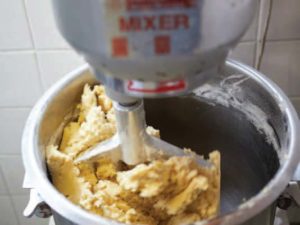
Add your flour and mix it until the dough leaves the side of the bowl. Once you can’t see any traces of butter then it’s ready to go. Don’t chill it, don’t wrap it in plastic—use it straight away.
If you overbeat it, it’ll loose it’s shape during baking and be difficult to handle and crumbly.
4. MOULDING THE DOUGH
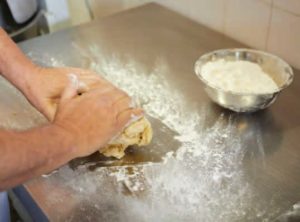
Once you take the dough out of the bowl, it’s all messy. You’ve got to have a nice square to roll it out plus it’s got to have no cracks in the top, so you need to mould it.
Put it on the bench and mould it with your hands. Moulding gets rid of any air bubbles and cracks in the dough. It’s not kneading; you’re taking the dough out and moulding it into a compact dough.
We use our hands because it’s kinder on the dough—if you don’t treat it kindly, it won’t work. Because I’m part Aboriginal I think it’s the spirits—everything to me is spirits—and they make it crack on top, so if you’re kind, it’ll eat better.
It’s ready for rolling when there are no cracks visible in the dough.
Be careful not to over-mould the shortbread. Doing so will melt the butter because of the warmth of your hands and your shortbread will be tough.
5. ROLLING THE DOUGH
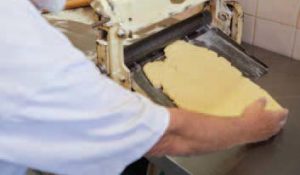
We use an old roller by hand because if you put it through a mechanical roller, the speed of the roller creates frictional heat and that’ll toughen the shortbread. So you’ve got to roll it out slowly.
We feed it through two rollers and we take it through about three times. We close the winders down and up four times and that gives it a thickness of about a centimetre.
Make sure you don’t have too much flour on the bench when you’re putting it through the roller. Because that flour gets incorporated into the dough, which means you’ve put too much flour into your shortbread and it’ll go crackly and dry and horrible. It’ll cause the shortbread to shrink and you don’t want shrinking shortbread.
Just dust the bench with enough to stop it sticking. Sometimes during summer if it’s really hot and the bench is a bit too warm for the butter, we mix a bit of corn flour with the flour to dust the bench. It keeps the butter slippery enough to go through the rollers.
6. CUTTING THE DOUGH
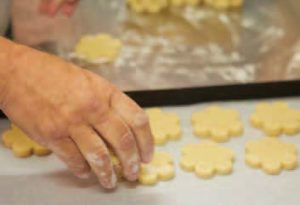
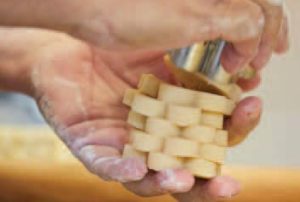
If you use anything other than a metal cutter you get a curvy side and you’ve got to have straight sides.
7. LINING THE TRAYS
We use silicone paper on our trays to keep the bottoms of the shortbread clean.
In old bakeries we used to use white oil and put everything on that, but these days you don’t really know what the components of the greasings are; we don’t know whether there’s any carcinogenics or anything like that in it.
We know that silicone paper is clean and there’s no flavour in it that will come out into the biscuit. It keeps our trays clean, too.
8. BAKING
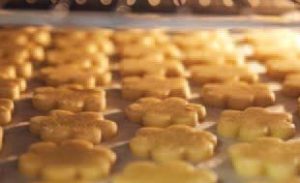
Place them on the tray and bake at 160 degrees. When you bake, keep an eye on it. Shortbread shouldn’t be brown; it’s got to be pale.
Touch the top with your fingers to make sure there’s a bit of resistance there. If you touch it and leave that little mark it’s not ready yet.
It takes about 20-25 minutes and we turn the trays around halfway, just to make sure it’s even.
If you over-bake them, you lose the nice flavour of the butter and it becomes bitter. Never be afraid to open the oven door—they’re better slightly under than over. They’re ready just before they brown.
You won’t know if you’ve got the shortbread right until the taste test. You have to eat it—we taste them all the time. It should be pale, brittle and snappy with no after taste or fatty film.




COMMENTS