


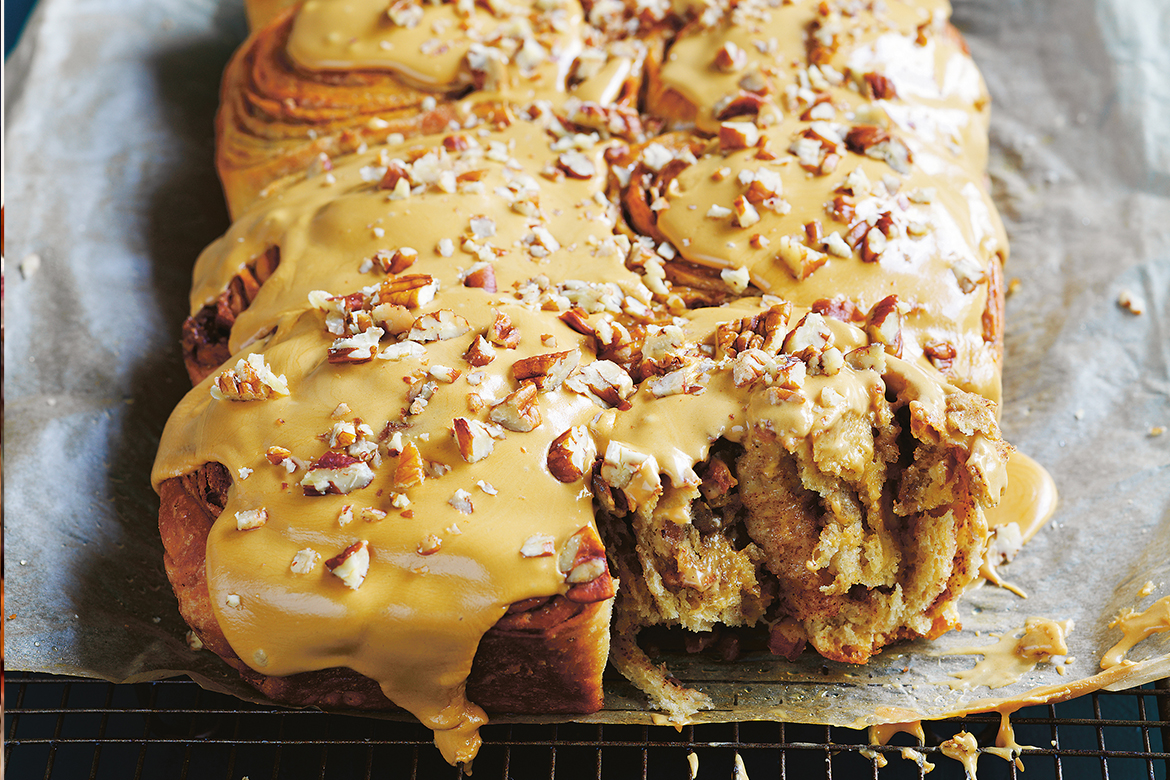
This is a gateway recipe to proper babka, in that you don’t have to go to the trouble of twisting and twirling the dough into loaves. Here, we just chop the dough into scrolls, which is a useful trick you can use for other doughs and pastries, folding the filling enough to protect it from burning, while scoring layered bits of flavour in shareable scroll form. The yeasted dough recipe is a gift from Alice Zaslavsky’s favourite babka baker in Melbourne, Avi, lightened with the inclusion of a tangzhong step (a process that gives milk buns their fluffiness, and something Alive learnt from Lorraine Elliott’s excellent hot cross bun recipe; worth seeking out at Easter time). You can freeze any left-over baked scrolls, sliced in half, to pop into the toaster for easy refreshing.
Makes 12
WHAT YOU NEED
For the tangzhong
2 tbsp plain (all-purpose) flour
125ml maple syrup
60ml strong espresso coffee
For the scroll dough
2 eggs, at room temperature
650g plain flour, plus extra for kneading and rolling
1 tbsp dried yeast
1 tsp sea salt flakes
100g butter, cut into cubes and softened
For the pecan and cinnamon sugar filling
50g pecans, plus 12 halves for topping*
55g raw sugar
2 tsp ground cinnamon
100g butter, cut into cubes and softened
For the coffee glacé icing
125g icing sugar
1 tbsp hot strong espresso coffee
*You can use any nut here, from walnuts to hazelnuts.
WHAT TO DO
Start by making the tangzhong. Add 125ml water and the flour to a small saucepan. Stir vigorously with a wooden spoon over medium heat for 2 mins; the mixture will start to thicken and become glossy at this point (65°C). Turn the heat off. Add the maple syrup, coffee, and another 125ml water and whisk well, cooling the temperature down to 45°C.
Next, make the scroll dough, which you can do by hand or using a stand mixer. If you’re going with the second option, place the tangzhong and eggs in the mixer bowl. Using the paddle attachment, mix for a minute or so, until blended. Switch over to the dough hook and add the flour, yeast and salt. Give them a whir on low speed for 5 mins, scraping down the side of the bowl now and then.
When the dough has stopped clinging to the bowl, up the speed a little to medium–low and, with the motor running, start adding the butter, a few cubes at a time. Wait for it to assimilate before adding more. Continue to do this for about 10–15 mins, scraping down the bowl every now and then if need be, until the dough is lusciously soft and elastic and comes away from the side of the bowl with ease. If it is still sticking, add another tablespoon or two of flour — max! — and keep mixing until incorporated.
Slosh a teaspoon or so of greasing oil over a dinner plate or small tray, spreading it around with your palm. Pile the dough on top and shape into a 10 x 20 cm rectangle. Cover with plastic wrap and leave to chill in the fridge for at least 12 hours, preferably overnight.
If you don’t have a stand mixer, no biggie! Use a wooden spoon and some elbow grease to combine the tangzhong and eggs to a uniform custardy colour. Put the flour, yeast and salt in a large bowl, giving it a mix with your wooden spoon. Make a well in the centre and pour in the egg mixture, stirring until it comes together and is raggy and sticky.
Turn out onto a floured bench and start kneading. The mixture will be sticky and a bit hard to handle, but persevere, and keep some flour handy to dust the bench now and then — but not too much, as this is a loose dough.
Start adding the butter, one cube at a time, and knead into an elastic dough; this will take about 10 mins. The process will be messy, but it does work. Once done, add the dough to a clean bowl. Cover with plastic wrap and leave in a warm spot for 2 hours, or until doubled in size.
Punch down the dough, then place in the fridge for 1 hour.
To make the filling, spread the pecans on a baking tray and toast in a preheated 160°C oven for 8–10 mins or until golden and aromatic. Place in a clean tea towel and give them a gentle whack with a rolling pin, remembering that you want the bits to still be chunky. Mix in a bowl with the sugar and cinnamon.
When the dough is ready to go, line a large baking tray with baking paper, and dust a clean bench and rolling pin with flour. Roll the dough out into a rectangle roughly 55 x 65 cm, keeping the dough well-floured by flipping it over every now and then. The dough is very pliable and forgiving, but will stick to the bench if there’s no flour underneath to form a barrier. The dough should end up about 5mm thick.
Using an offset or flexible spatula, spread the softened butter across the whole surface to the very edges, in an even layer. Set some of the filling aside to sprinkle over the scrolls just after glazing. Sprinkle half the remaining filling over the dough. Fold the dough into thirds. Roll out again and sprinkle with the remaining filling, folding until you have a neat rectangle about 2cm thick. Roll up tightly, starting at the long end. Cut into 12 even scrolls and place, swirl side up, on your baking tray. (To make these uniform in size, you can cut the log in half, then cut each of those halves in half, then each of those pieces into thirds.) Cover loosely and leave to prove in a warm spot for another 1 hour. Almost there!
Preheat the oven to 170°C. Bake the scrolls on the middle rack of the oven for 30–40 mins, or until they’re golden brown, and a skewer comes out clean of dough; a bit of filling is okay.
To make the icing, sift the icing sugar into a bowl, pour in the hot coffee and whisk until smooth. Spread or drizzle over the scrolls once they’ve cooled slightly. Sprinkle with the reserved filling and give yourself an artful pat on the back while you and yours dig in.
These scrolls are best eaten within the first 2–3 days, and can be brought back to life with a microwave zapping or a little time in the oven to reheat. Store in an airtight container in the fridge.





COMMENTS