


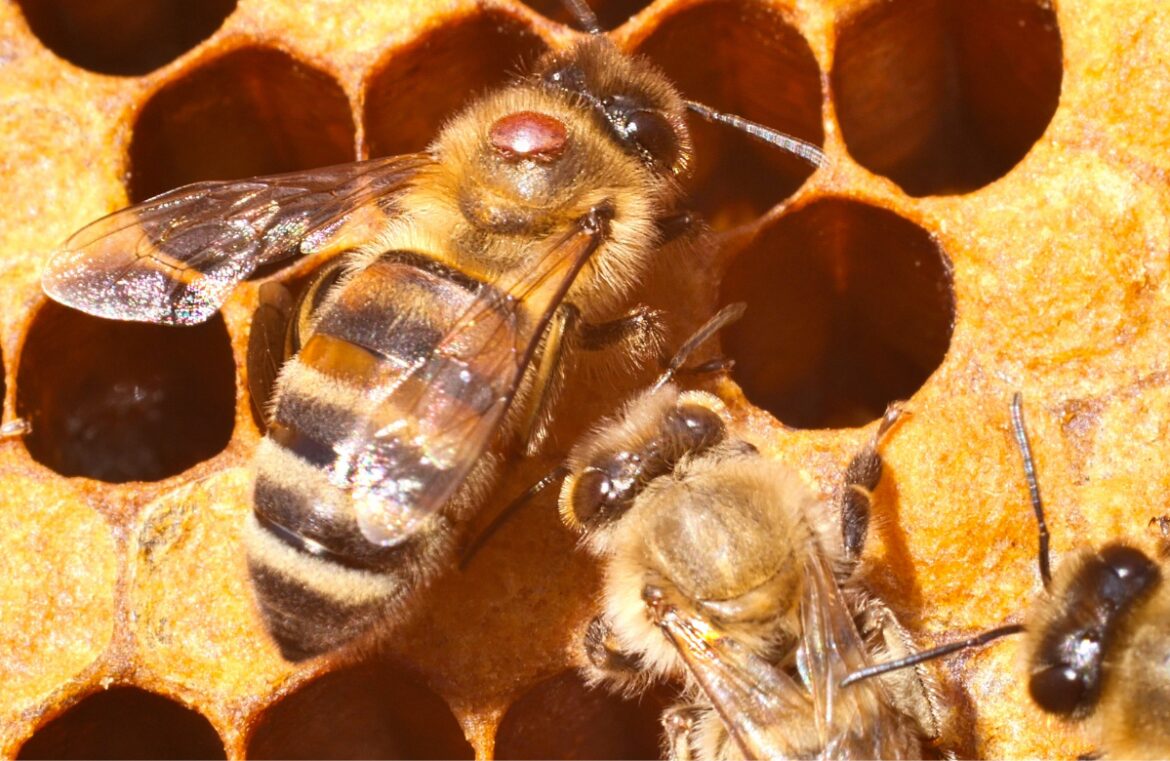
In a move that sounds like it’s come straight from a Marvel movie, a scientist from the University of the Sunshine Coast (USC) are investigating the use of spider venom to help fight the varroa mites decimating bee colonies across Australia.
The varroa mite, also known as Varroa Destructor, is a parasitic mite that was first discovered in Australia in 2022, and since then has spread across five states and territories. Described by the CSIRO as the world’s worst and most serious European bee parasite, varroa mites can kill entire honey bee colonies and pass on numerous viruses to their hosts.
According to ABC News, the varroa mite not only poses a serious threat to the Australian agriculture sector as more than 30 per cent of food production – approximately $4.6 billion annually – relies on bee pollination, while the Australian $237.5 million honey market is also under threat.
However, Associate Professor Volker Herzig from USC and his team may have a potential answer. Their research has identified components in the venoms of the Tasmanian cave spider and the Giant Japanese funnel-web spider that killed the parasitic mites without harming the bees.
Associate Professor Volker Herzig said the discovery was the first step in finding a new, environmentally friendly way to combat varroa mites, which were destroying honeybee colonies across the globe.
“We screened 50 venoms, mostly from spiders and scorpions, by applying them externally to the mites. We found more than 75 per cent killed the mites within 24 hours. We selected two of the most potent spider venoms for further analysis,” Dr Herzig said.
“We isolated a specific component, called a peptide, from each of these two venoms and applied them to the bodies of varroa mites. The peptides killed only the mites, while the bees survived.
“These peptides, which we named Ht1a and Gg1a, are fully biodegradable and our findings suggest they could be developed into a commercial, sustainable treatment for varroa mite infestations in honeybee hives.”
Dr Herzig further explained to ABC News that as both spiders and mites are arachnids and they eat each other, they also have toxins in their venom that target each other.
“We’ve identified these two venoms that had really good activity against the varroa mite,” he said, adding using the spider venom peptides was a more organic way of killing the mites than using synthetic treatments.
“It doesn’t accumulate in the food chain. It doesn’t kill any other organisms, like the farmer or beekeeper or any pets – it’s selective to the varroa mite.
Dr Herzig said a $50,000 Community Bee Innovation Fund grant from the Queensland Government, received earlier this year, would further the research, and he said the next steps would include testing the two peptides on honeybees carrying varroa mites and applying them in mite-infested beehives to assess how well they work under real world conditions.
If that works, then we could design a sprayable treatment… the mites will hopefully drop dead and the bees stay alive,” he said.
Dr Herzig said it could still be several years before the spider venom spray would be available to Australian beekeepers.
The study involved collaborators from UniSC, The University of Queensland, The University of Oslo, Ghent University in Belgium and the Swiss Bee Research Centre Agroscope in Switzerland.



COMMENTS