


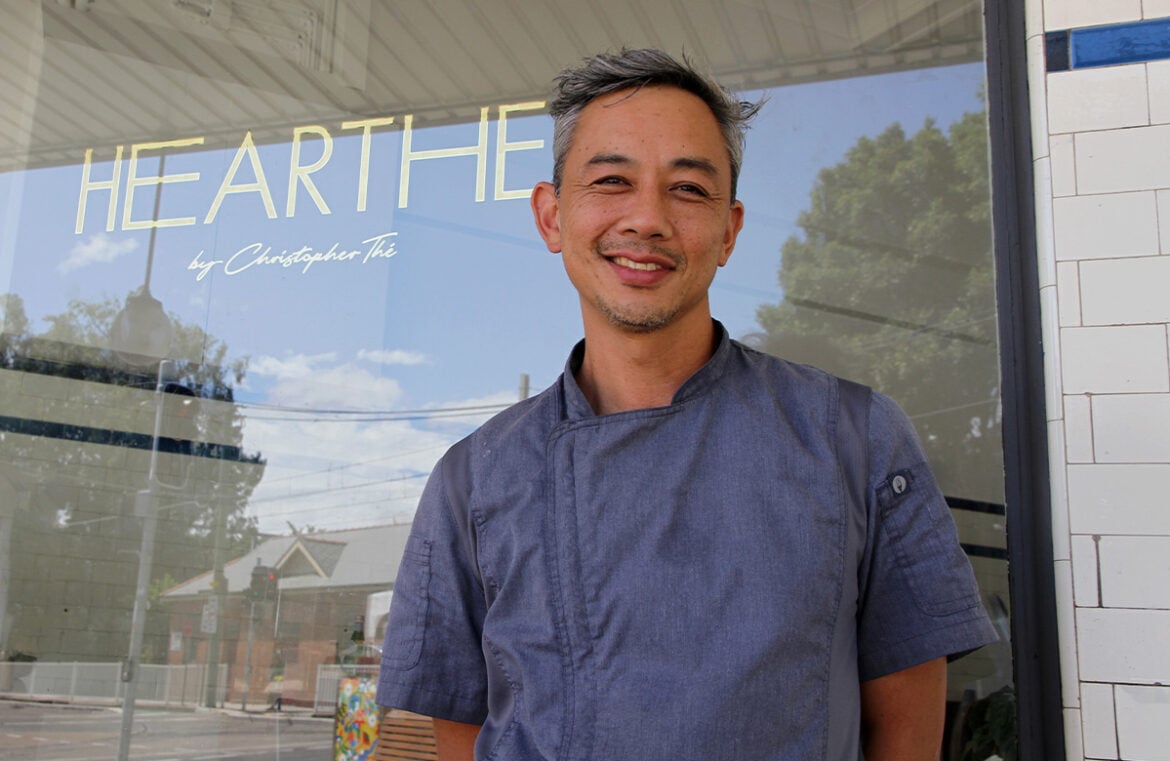
Christopher Thé, the name behind Blackstar Pastry and Hearthe, has recently released his first cookbook, Modern Australian Baking.
In the cookbook the lauded pastry chef delves into the cakes, bread and pastries that have helped to shape the Australian culinary scene. Taking inspiration from his own lengthy career, Chris created more than 80 sweet and savoury recipes that not only focus on seasonal ingredients, but has also elevated each of them with native ingredients. Think saltbush scones with desert lime marmalade, Geraldton Wax Cheesecake with Strawberry Gum Biscuit and even lamingtons – featuring green ants!
We caught up with Chris following the release of the cookbook to hear all about the creative process behind Modern Australian Baking.
Baking Business: What was your inspiration for Modern Australian Baking – where did the idea come from?
Chris: I’ve had quite a long career in baking, and it’s taken me this long to write a book. I really wanted to have something to say before I wrote one. Even through Blackstar [Pastry], I didn’t do one.
The whole purpose of the book is to help everyday Australians just start to use these native Australian ingredients, which I’ve come to love and understand, in their everyday cooking. It’s kind of like a guide, something to help everyone to start to learn about these things.
Where do you begin working on a cookbook like this?
I think that I needed to cover all aspects of baking, from home cooks to things to professionals do, like very technical work. There’s something in this book, Modern Australian Baking, for everybody. But it not only talks about what we’re doing now, but also I think ideas that will take
What did the recipe testing process look like for you?
That’s a great question. Some of these recipes I know like the back of my hand, and some of them needed a little bit of tweaking. There were some I felt a book that covered modern Australian baking would be incomplete without. For example, a lamington – I knew we’d need a lamington recipe. Then some of them were purely theoretical. I knew they would work but hadn’t tested them in reality.
Someone asked me a similar question at the book launch. They said, “what do you mean by a recipe that works in theory?”. A great analogy is in music, where you’ve got a scale and you’ve got a key signature and you know that works. In theory, you can write the music without hearing it. A lot of composers do that. I think I used that kind of technique to do a lot of the food, because I really wanted to push boundaries and make up new things.
One thing I loved when flicking through the book was that you would give the native ingredients, but then also an alternative. I found through this I could work out the flavour profile and it made the recipe more approachable.
That was tricky. I have access to all these ingredients, but most people don’t. So [the question is] will they actually try these recipes, or are all the ingredients too strange? So, we made sure that there was substitute, and the substitutes, like you said, help you kind of understand what the native would taste like.
What was your personal favourite recipe to develop for the cookbook?
My favourite one to make, I have to say, are the saltbush scones, and that’s a very easy recipe. We do it here at Hearthe all the time. [The salt bush] just elevates it; it transforms the flavour. Our scones are quite simple. They’re just self-raising flour, cream and lemonade – very CWA-style. Without the saltbush it’s very one dimensional, but with that addition suddenly the recipe takes on a complexity and depth. And I love that. I love the way that it’s transformed just by that simple step. Then that’s served with desert lime marmalade and cream, and I think that’s just a perfect.
What native ingredient should others try if they’re new to them?
I think if you haven’t had much to do with native ingredients lemon myrtle – or anything lemon – is a really good starting point, because you can get it very readily and it really has a very approachable, lovely flavour. Finger limes is the other one I’d recommend.
A lot of a lot of native ingredients can be a little bit hard to work with at first – but not all of them.
You’ve had a quite a busy few months with Modern Australian Baking. What does the rest of 2025 hold for you?
Well, I’m still here baking every day at Hearthe. After I finished at Blackstar, I just missed the craziness of small little bakeries. So, I’m here every day in the morning, baking. But the best thing about writing that book is it kind of forced me to create the next chapter of the items of food that we want to do here.
All the recipes are in the book. I just say to my guys, “hey, you know the recipe from this page? That’s going to make this”, so that’s a really handy thing to have.
Other than that, it’s pushing ahead with the food here, and a little bit more time to look after my garden in the back, where we grow some of these native ingredients. It’s not very big, but what I’ve found is that if you just focus on one or two niche items it works.
We’ve got lots of pig’s face, which goes into our salads and other dishes, and we’ve got lots of native thyme. We can supply ourselves with these two ingredients, whereas some of what we need, like saltbush and warrigal greens, we go through so much, there’s no way we can grow everything we need.
Modern Australian Baking is available now.




COMMENTS