


Jodie Cameron left her corporate job in Brisbane to start up a macadamia farm with her husband Michael. We asked her about life at Barenuts Macadamia Nut Farm on Queensland’s Fraser Coast.
How long have you been at Barenuts?
We purchased the farm and business just over three years ago. We had to hit the ground running once we purchased the property because, at that stage, Michael was still working a FIFO job in south-west Queensland and was only at the farm every two weeks.
What prompted you to make the change from corporate life to the farm?
Living in inner-city Brisbane we grew tired of listening to every movement and conversation our neighbours had, so began to dream of what it would be like to have none. Michael grew up on an organic wheat farm in south-west Queensland, so he knew all too well about the serenity and freedom we were missing out on. I grew up in the Gold Coast Hinterland, so I also missed the wide-open spaces but I didn’t expect it to be this quiet. It’s really lovely.
How many trees do you have?
We currently have 2000 mature trees: 816s, Daddows and 741s. In 2016, we started the Barenuts Nursery and now have 6000 immature trees, which we will be planting after summer.
We have 90 acres and our dream is to one day fill it entirely with macadamia nut trees. It’s an ambitious dream given some trees can take up to seven years to produce nuts, but we are in the midst of grafting some newer varieties which are a smaller growing tree that yield the same as a larger tree. The idea of them growing smaller means less maintenance (pruning etc.) and we can fit more in per hectare. The trials for these trees are only quite young so it’s a lot of trial and error with macadamia nut farming. We’re happy givin’ it a crack!
What is a raceme?
A raceme is the flower or blossom that grows on the macadamia nut tree. They look like a bottlebrush, not dissimilar to the native bottlebrush trees and ours are yellow, but some varieties can be white or even pink. They start out as a long green stem, which then grows tiny nodules all over it and the natural pollinators come in and boom, you have the most amazing smell of honey all over the farm.
How do you know you’re in for a good harvest?
When you can hear the bees and other natural pollinators buzzing around the orchard from the house. During spring, when the racemes are in full bloom, literally all you can smell when you walk through the orchard is sweet honey—it’s a pretty special time of year. Despite being in drought part of 2017, we are lucky to receive quite a high annual rainfall so if we get a lot of winter rain and cool weather, then the ground will stay nice and cool for the pollinating season too.
How do you collect the nuts?
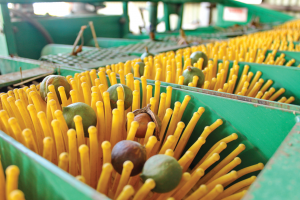
We use a finger wheel harvester, which attaches to the front of the mower. It’s similar to the machine that collects golf balls. There’s a sweeper at the front which sweeps the nuts into the hard-tooth comb on the front of the harvester and as it runs over the nuts, they stick into the hard-tooth comb and then they are augured into a bin on the back of the mower.
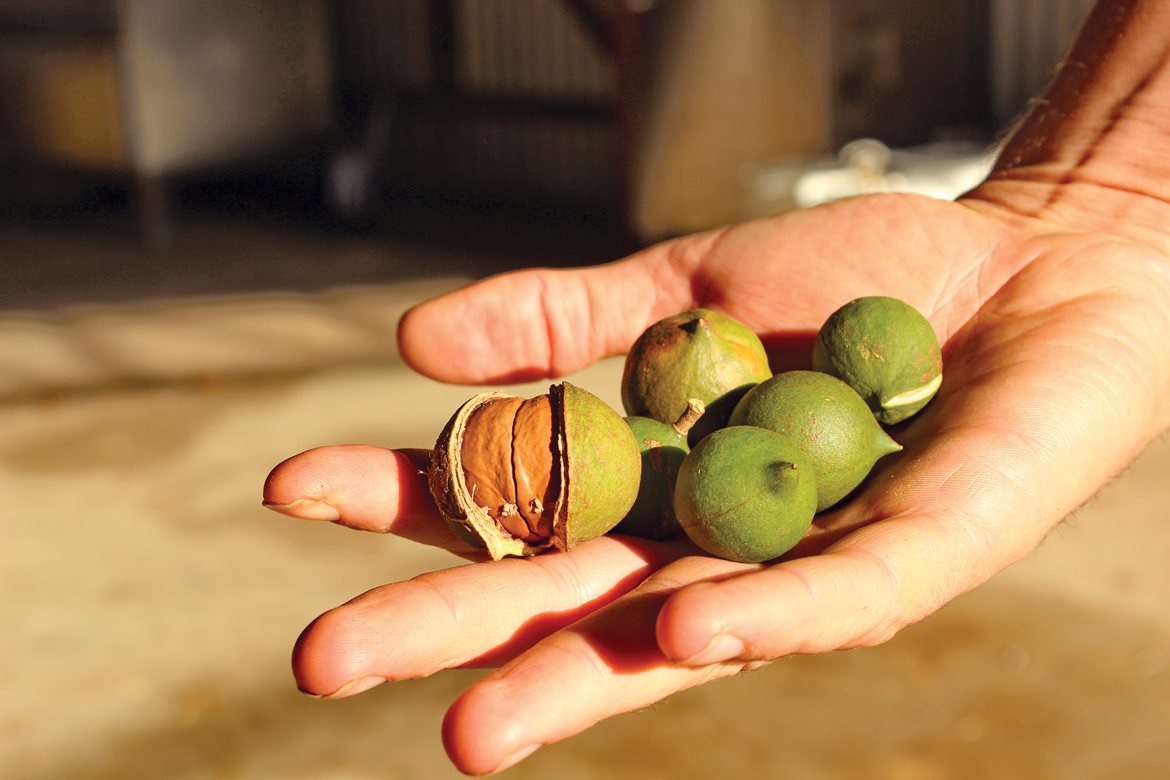
Once Michael has harvested the nuts, they are loaded into the de-husker, which removes the outer husk and leaves the nut-in-shell.
Where do you dry the nuts?
Once the nuts are de-husked, they are stored in a silo for a week or two, which helps dry any moisture that might be in the nut before they are sent to our local co-op where they are cracked. The co-op stores the nuts and we usually have 500kg delivered at a time and I will value add these in our commercial kitchen at the farm.
What makes a good macadamia nut?
A good macadamia nut should always have a lovely buttery flavour. Nothing beats a fresh macadamia straight from the shell; this is by far our favourite way to eat them, more so than when they have been roasted or flavoured. The size of the nuts can also vary with some varieties.
What should baking business readers know about macadamia nuts?
When you are baking with macadamia nuts it’s best to use raw kernel but when you are styling or using them to ‘dress’ up a dish, roasted kernel will give your salads, smoothies and muesli a lovely crunch. Macadamias are extremely versatile, too, so can pretty much be added to any savoury or sweet dish. I use our Barenuts Macadamia Nut Butter as a thickener in soups and stews and I’ve used ground macadamias as a breadcrumb, hence why they pretty much creep into every meal in our house.


COMMENTS