


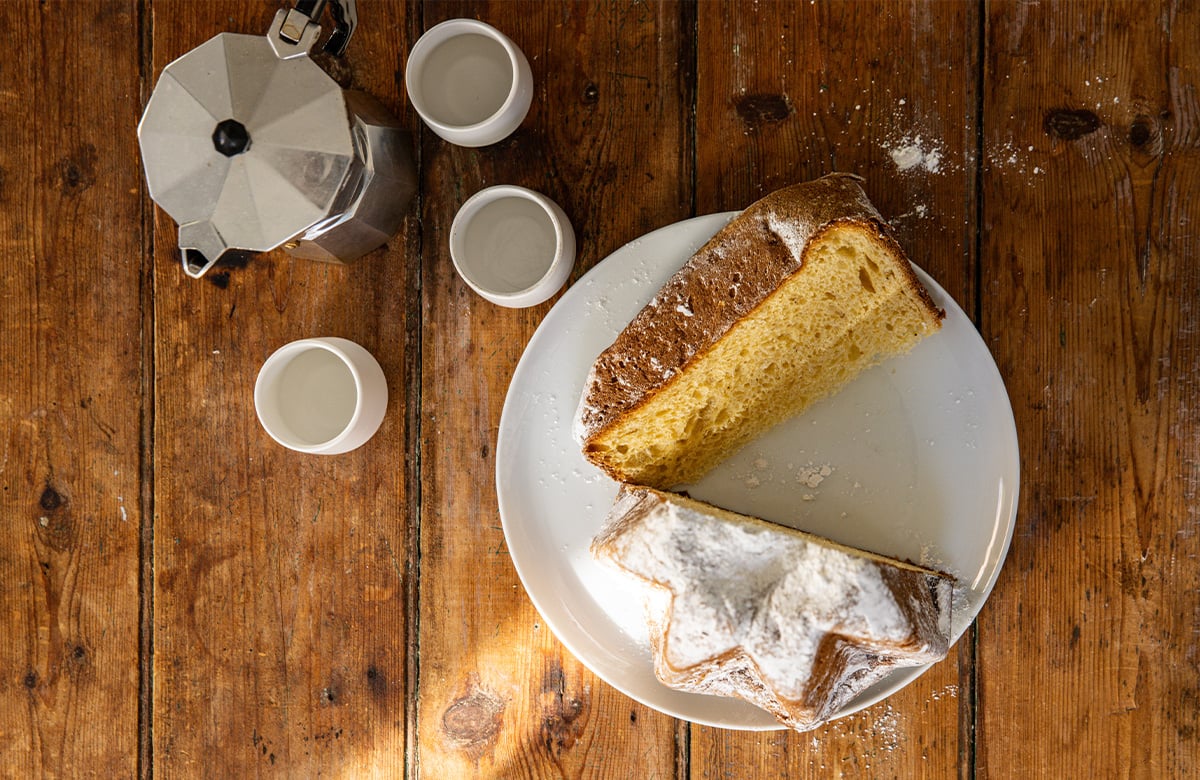
The history of the pandoro extends back to Verona, Italy, where as the story goes confectioner Domenico Melegatti was the first to patent this soft, star-shaped cake. The exact origin of the cake, however, is not so clear cut.
Similarities to the star-shaped Nadalin – a cake that graced Venetian tables in the 13th Century – have been noted, and the names has also been linked to the pan de oro, a conical cake covered with thin, gold leaves, which was popular in the Venetian Republic in the 1500s.
Regardless, the pandoro is the perfect festive accompaniment, which is best served slightly warmed.
Luis Cavuoto from Pasticcino shows us how to make this Italian classic, using a recipe inspired by Italian master Rolando Morandin.
 About Luis Cavuoto:
Luis began his culinary career at the age of 15, and over the past 16 years has built a reputation for craftsmanship, creativity, and dedication to tradition. Trained as both a chef and pastry chef, his expertise spans artisan gelato making, chocolate and pastry production, along with extensive experience as a chef across South Australia and abroad.
In 2016, Luis founded Pasticcino in Adelaide South Australia. A boutique business producing artisan Panettone, Colomba di Pasqua, and Pandoro.
Each creation is made by hand using natural fermentation, carefully sourced ingredients, and techniques that honour centuries-old traditions while introducing a distinctly Australian touch. But more importantly a product that does not contain any preservatives and the candied fruit is made by hand each season.
In 2024, Pasticcino received the Slow Food Snail of Approval, a recognition awarded to producers who embody the Slow Food philosophy of “good, clean, and fair.” This distinction highlights his commitment to quality, sustainability, and preserving artisanal methods in a fast-paced, industrial food culture. Being Snail Approved means that Pasticcino is celebrated not only for its exceptional flavour and craftsmanship but also for its respect for the environment, seasonality, and community values.
Shokupan 2.0
WHAT YOU NEED
|
First Dough (Evening dough) |
|
| Sugar | 215 |
| Water | 196 |
| Egg yolk | 307 |
| Lievito Madre | 245 |
| Flour | 491 |
| Butter | 245 |
|
Morning dough |
|
| First dough | 1,700 |
| Flour | 307 |
| Custard | 123 |
|
Emulsion |
|
| Sugar | 49 |
| Egg yolk | 61 |
| Vanilla | 1 |
| Butter | 184 |
| Salt | 15 |
| Honey | 49 |
| Cocoa butter | 61 |

WHAT TO DO
Before you start
On the day of production, feed the Lievito Madre (sourdough starter) three times before proceeding with the recipe. Depending on the conservation method, we can proceed by refreshing the Madre with the following ratios: 100gm flour, 100gm yeast, 50gm water. Knead until a homogonous mass. Make a cross with a sharp knife and leave to ferment for 3.5 hours at 26-28 degrees in a prover.
Method – First Dough (Evening Dough)
Place the sugar, half of the egg yolks, and half of the water into the mixer. Knead on low speed for about 10 minutes.


Add the flour and yeast while continuing to knead. Once the dough begins to hold its structure, gradually incorporate the remaining egg yolks and water.
When the dough firms up again, work in the butter.

Continue kneading until the mixture is smooth and elastic. Transfer the dough to a large container and allow it to rise at 24 °C for 12–15 hours.
Prepare the emulsion using the listed ingredients, then refrigerate until needed.

Method – Second Dough (Morning Dough)
Once the evening dough has tripled in volume, transfer it to the mixer and add the flour.
Knead until the dough is firm, then incorporate the custard and the prepared emulsion in three additions.

When the dough is fully mixed, place it on the work surface and divide into portions of 1150g each.
Shape each portion into rounds and place into pandoro moulds. Allow to rise for approximately six hours.

Once risen, score a cross in the centre of each dough and bake in a convection oven at 150°C.
After baking, remove from the oven and leave the pandoro to cool in the moulds for at least 2 hours. Unmould and continue cooling for a further eight hours before serving or packaging.



COMMENTS