


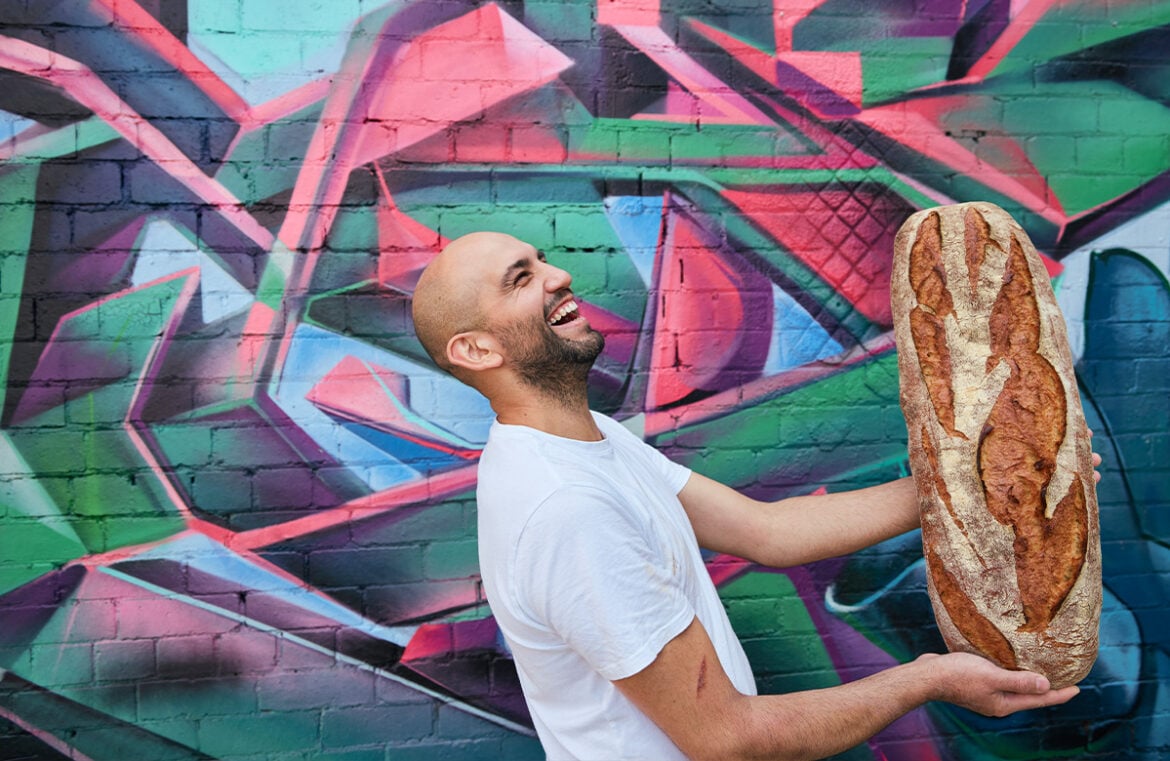
Food tech has evolved a lot since the dawn of the first sourdough, yet the bread remains a staple in Australia’s bakery scene—so what makes these ancient loaves so unique?
Perhaps it’s sourdough’s crusty exterior, soft interior and subtle tang that pairs well with almost any condiment. Perhaps it’s the craft of the making process, which requires strict practice, patience, and persistence. Whatever the reason, sourdough remains a favourite among bread fanatics today. So, it might come as a surprise that the noble loaf hasn’t always been so popular; in fact, it was born out of necessity and is the world’s most ancient form of leavened bread.
The history: sourdough’s rise to fame
One of the oldest sourdough breads dates to 3700 BCE and was excavated in Switzerland, according to The Encyclopedia of Food Microbiology. However, sourdough fermentation likely began several thousand years earlier with the origin of agriculture in the Middle East’s Fertile Crescent. Ancient Egyptian bakers refined the practice, using wild yeasts and lactic acid bacteria to transform simple doughs made from emmer and barley into lighter, more flavourful loaves.
Sourdough travelled across Europe and Asia with the cultivation of grains, and regional variations were forged due to differences in climate and crop availability. Wheat-based loaves were prominent in the Mediterranean, whereas tangy rye sourdoughs dominated Germany and Scandinavia. During the 1850s gold rush, French bakers brought sourdough to Northern California, and its impact is still evident today—‘Sourdough Sam’ is the current mascot of the San Francisco 49ers.
From one gold rush to another, sourdough was brought to Alaskan and Canadian territories during the 1898 Klondike Gold Rush. Common leavenings like yeast and baking soda were sensitive to the conditions faced by the gold prospectors, so experienced miners often carried a starter pouch around their necks.
Old-timers became known as “sourdoughs” and are still called this in regions of North America today.
Sourdough holds significance in other parts of the world too. Its use in ceremonies extends from Orthodox liturgies to Polish weddings, where parents welcome newlyweds with bread and salt. It’s also sometimes used as a funerary ritual to symbolise fertility and renewal.
Sourdough was the mainstream method of breadmaking until the Middle Ages when it was replaced by barm, and it’s only been about 150 years since baker’s yeast came into the mix, reducing fermentation times and seeing bread produced on a much larger scale.
While commercial yeast has revolutionised modern breadmaking, many artisanal bakers are drawn to sourdough for its authentic heritage, rich flavour and health benefits.
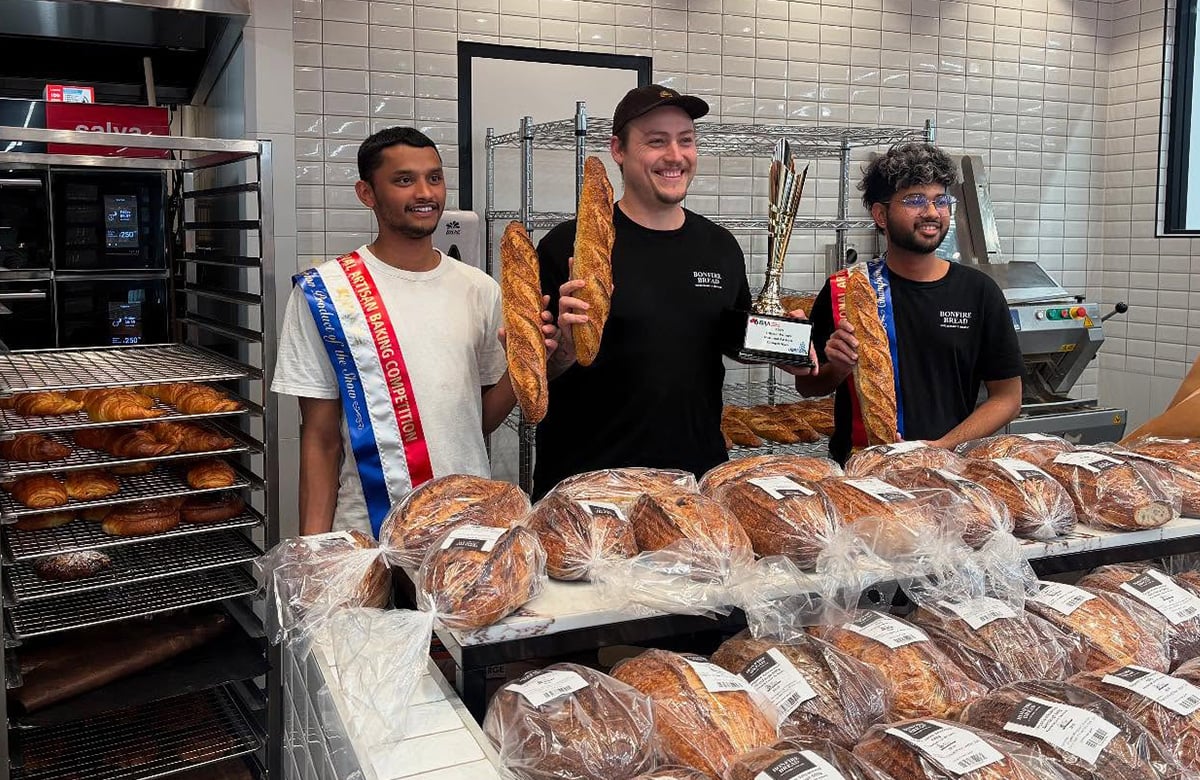
The award-winning Bonfire Bread team
Sour-dos and don’ts
Its ingredient list is straightforward – flour, water, and salt – but the correct process by which sourdough is made is less clear. We chatted with some of the industry’s best to get the low-down on what makes the perfect sourdough.
Sydney based Bonfire Bread recently took home first prize in the Artisan Baking Competition for their rye sourdough at the Baking Industry Trade Show earlier this year. Third-generation baker and Bonfire Bread owner Jarrod Austin said their award-winning sourdough was a natural evolution in their product range, and is the foundation from which all the family business’ products are created.
“Our products stand out because of [a] deep passion for the craft, and a commitment to using the finest ingredients. We believe this dedication consistently results in an award-winning product that resonates with judges and customers alike,” Jarrod said.
“From a baker’s perspective, sourdough is incredibly exciting because it’s an art of transformation. While the ingredient list is deceptively simple, creating a perfect loaf requires a blend of science and artistry. You start with a foundation of technique, but it’s the passion to consistently chase that ideal loaf that truly drives the process.
“My father and I spent countless hours side by side, perfecting our sourdough through trial and error, and with a genuine love for the craft. The technical aspects can be learned, but without a genuine passion for the craft, it’s difficult to persevere and excel.”
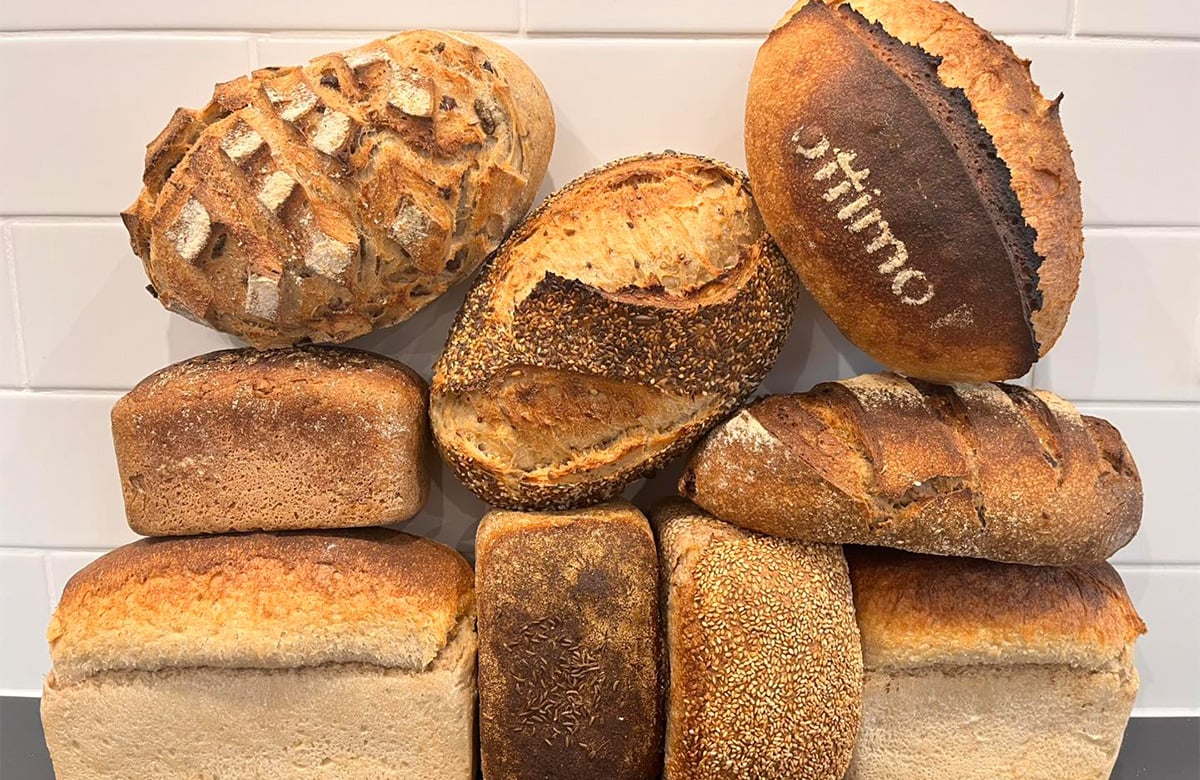
Ottimo Bakery sourdough
Ottimo bakery owner Rebecca (Bec) Bremner says her passion for sourdough came from a wish to nourish her family with the highest quality bread. What started as a micro home business in 2022 has now expanded to a shopfront in the main street of her hometown in Sunbury, Victoria.
“Our sourdough is what I’d call authentic sourdough; we use organic and sustainably sourced Australian flour and don’t add any commercial yeasts or improvers to our dough,” Bec said.
Bec spent months testing, tasting, and refining her recipe to perfect Ottimo bakery’s iconic sourdough, which has won several awards—most recently in the Most Successful Specialty Bread Category at the 2025 Bendigo Show. She believes a great sourdough comes down to understanding the maths and chemistry involved.
“The maths component is getting the ratios right in the recipe … [the] quantities of flour, water, levain (starter) and salt.
“The chemistry component is twofold. [Firstly], there is a chemical reaction that happens between the protein in flour when [it’s] mixed with water. Gluten is created and the longer we mix the dough the better the gluten forms. We need strong gluten bonds in the dough to form during mixing and stretch and fold, so that the air bubbles hold up and don’t collapse during baking.
“[Secondly], the lactobacillus (bacteria) in the levain creates a chemical reaction with the gluten … the lactobacillus then gives off carbon dioxide [which are] the little bubble shapes you see in bread. I like to think about the lactobacillus like babies that need to be fed regularly. In the lead up to mixing dough we need to regularly feed or ‘clone’ our starter to ensure it is bubbly and resilient for bread making.”
“You need to make mistakes to learn the art of sourdough; you’re not going to get it exactly right the first few times. Sourdough never ferments in exactly the same timeframe… you need to see it and feel it to instinctively know at what stage it’s at. This can only be learnt by making sourdough over and over again.”
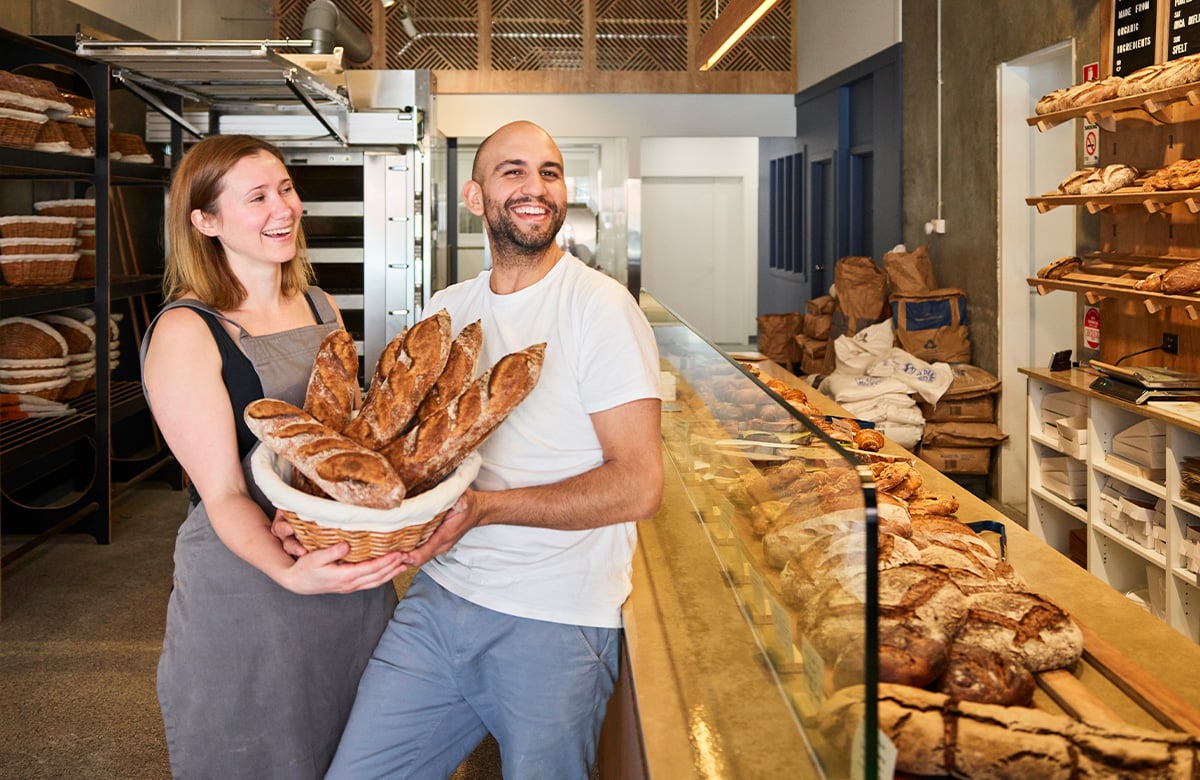
Franco Villalva and Lauren Parsons from To Be Frank Bakery
Building on tradition
Melbourne-based baker Franco Villalva is passionate about making bread that’s free of improvers, preservatives and artificial flavours. He sells a range of artisanal breads at his bakery To Be Frank, and aims to bring affordable, tasty, high-quality bread to the mouths of all Melbournians. We asked him for his sourdough’s secret ingredient.
“There are no secrets, the flour is key in this matter, and I have to say that every loaf is exceptional!” Franco said.
“[However], there are many factors to keep in mind like mixing, fermenting properly, [and] a big one is understanding the flour you are working with. But I believe one of the main ones is the health of your [sourdough] starter… controlling its environment and feeding process will help fix any issues. The health of your starter will determine the flavour, colour, acidity and character of your loaf.
“We do baguettes, rye breads, and some other specials very often. I believe in this case those breads are better done traditionally with Sourdough.”
Alongside To Be Frank’s sourdough range, Franco also works with a variety that sees yeast added to his breads through a method called ‘Respectus Panis’. A latin expression that roughly translates as ‘respect for bread’, this breadmaking method emerged in 2017 by the French baking association Les Ambassadors du Pain.
“…I am not against sourdough, I actually love it! And we are always trying to improve our sourdough loaves to feel more like our Respectus Panis range. I also think that some products are better done with yeast and we don’t need to demonise it,” Franco said.
“When I first took an interest in baking, I was looking to learn from anyone, and I had the luck to learn from a very close friend, Jonathan Valdman. They were using a technique called ‘Respectus Panis’ where yeast was used, but the ambient fermentation was three times longer than traditional sourdough style … which was very surprising for me as the bread was incredibly tasty, the crumb was soft, and the crust and colour were on point.
“Back then, ‘yeast’ was a bad word in my vocabulary, but that all changed when I learnt more about Respectus Panis and the results we were getting … and how my body reacted to that [style] of bread.”
“There are two main differences [from sourdough]. First, the bread isn’t sour … with sourdough, the sour taste found in most loaves [can] take over the flavours and aroma of the actual grain: wheat, spelt, emmer, etc. But with our technique you don’t have a yeasty flavoured loaf, instead you can taste the grains used in the bread or any additions to it. [The] second is the texture. The bread is soft and easy to chew through as it is fully fermented when it gets baked, and of course [it’s] easier to digest.”
Franco says no matter the method used, breadmaking requires an exceptional commitment of time, effort, and patience – all true testaments to authentic baking.
“There is so much work behind every loaf you see in any bakery … I put my hands down to all bakers keeping [up] the good work.”



COMMENTS